Massage Therapy, Reconsidered · Part 3
Where Hands Go Lightly and Current Never Goes: Endangerment Sites, Contraindications, and the Four Rules
Massage training spends real time on where not to press. Electrical stimulation needs the same map, redrawn for a force that travels. The zones, the reasons, and the rules that never bend.
By masseuse.aiUpdated 10 mins read
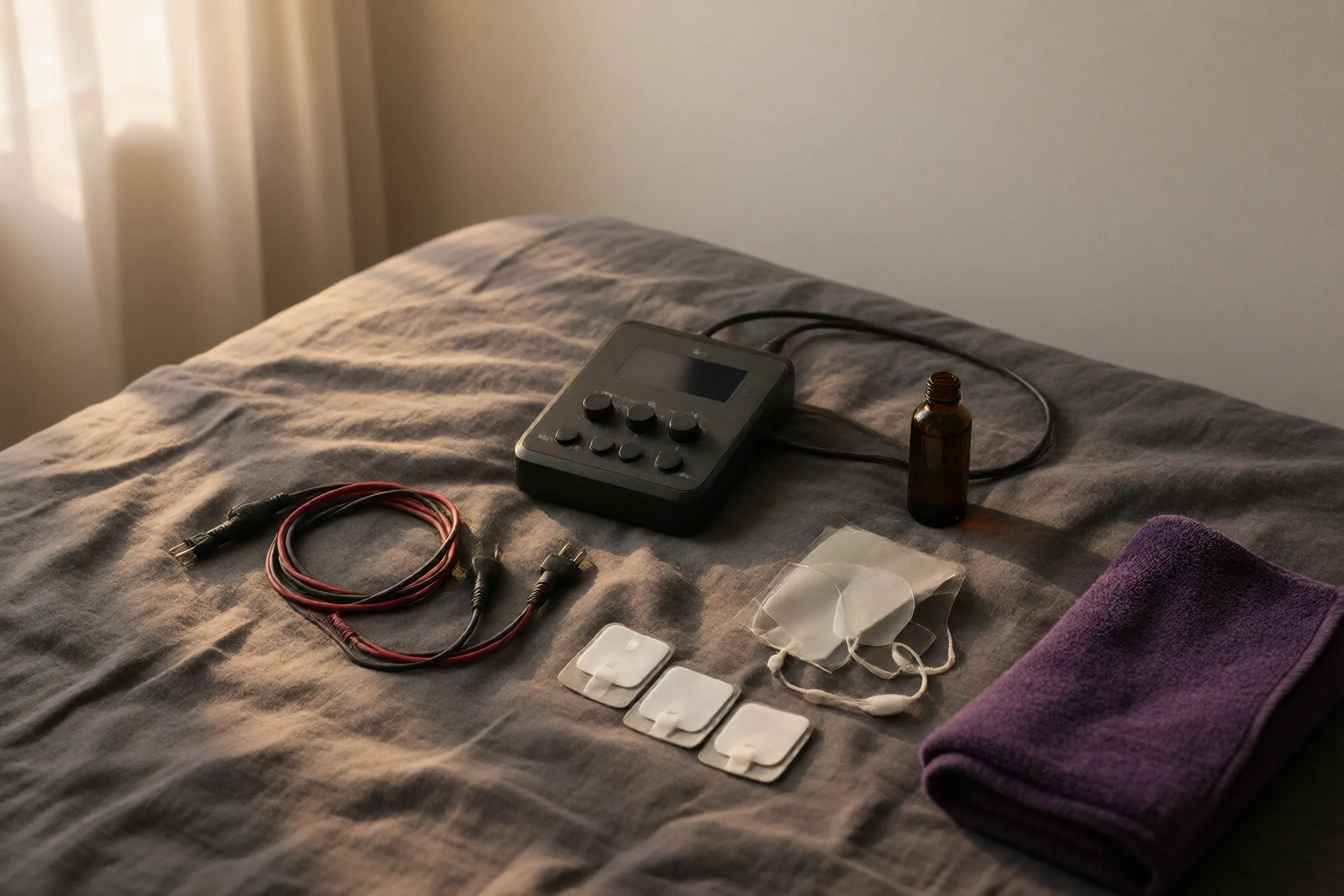
The most important pages in a massage textbook are not about technique. They are about restraint: the places on a body where pressure is dangerous, the days when a massage should not happen at all, and the conditions that turn an ordinary stroke into an injury. Students memorize these before they are allowed to work on the public, and licensed therapists screen for them at every intake, because the whole profession rests on a promise that the person on the table will leave better than they arrived.
We build a product that puts electrical current into muscle. The restraint chapter applies to us with extra force, and it needs one extension the textbooks were never asked to make. This post covers both: the human map of where hands go lightly, and the electrical map of where current never goes.
Two kinds of no
Massage separates its cautions into two categories, and the distinction is useful far beyond massage.
An absolute contraindication means no session today. The classic three: a contagious illness, a fever (the profession uses a measured 100.4°F as the line), or any state that amounts to a medical emergency.1 None of these is about the massage being risky to the tissue. They are about the body being busy with something more important, or about the therapist becoming the next link in a chain of infection. The advice for a therapist who wakes up with the flu is the same: cancel, and stay home until a full day has passed without fever and without fever-reducing drugs.
A local contraindication means the session goes ahead but a region is left alone. Anything freshly injured or visibly inflamed. Anything on the skin that has not been explained yet: a mole that has changed, a lump, a rash, a wart, a lymph node you can feel. And anything a doctor put there on purpose, from a pacemaker or an implanted port to a hormone implant under the skin or a medicated patch. The list is a reminder that skin is a surface over machinery, and some of the machinery is temporary and some is borrowed.
Electrical stimulation inherits both categories unchanged. Fever, contagion, emergency: no session. Broken skin, rash, recent bruise, unexplained swelling, implanted device: not there, and in some cases not anywhere. Everything that follows is detail on top of those two ideas.
The five endangerment sites
An endangerment site is a place where nerves, blood vessels, organs, or glands lie close to the surface without bone or thick muscle to shield them. The rule is very light pressure or none. There are five that every therapist knows by heart.
The front of the neck. Between the jaw, the collarbones, and the front edge of the big shoulder muscles sit the thyroid, the carotid arteries, the jugular veins, the vagus nerve, and the nerve roots that become the arm. This is, by a wide margin, the site most associated with serious harm from massage: torn arterial walls, clots in the jugular, nerve injuries, and even spinal cord compression from overenthusiastic neck work. Serious adverse events from massage overall are rare, well under one percent, and often do not announce themselves for days.2,3 When they do happen, this is usually where.
The abdomen. Organs and major vessels with nothing but muscle wall in front of them. The published case reports behind the caution involve internal bleeding and, in at least one instance, surgical hardware pushed out of place by deep pressure.2 The specific worry that keeps therapists cautious: a weakened aortic wall (an aneurysm) is common, usually silent, and usually undiagnosed. You cannot screen for it by asking. So the abdomen gets slow, moderate, informed work or none.
The lower back beside the spine, just under the last rib. The kidneys live here, loosely suspended in fat behind the abdominal lining. Gentle strokes are fine; forceful percussion is not.
The armpit. The arteries and veins that supply the arm and the nerve bundle that controls it pass through this small triangle with almost no protection.
The back of the knee. A diamond of soft space between the hamstring tendons and the calf, carrying the popliteal artery and vein and two major nerves of the lower leg.
Notice the pattern. Every one of these is a corridor where the body routes its wiring and plumbing through a gap in the armor. Hands are dangerous there because a hand pushes down, and what is underneath cannot get out of the way.
What changes when the force can travel
Here is the extension the textbooks were not asked to make. A hand delivers force at a point. Electrical current delivers it along a path: it enters at one pad, leaves at the other, and passes through whatever lies between. So the human map of endangerment points has to be redrawn as a map of forbidden lines, and the lines have to be drawn around one organ above all others.
The heart runs on electricity. A cluster of cells in the upper right chamber, the sinoatrial node, fires a rhythmic impulse that spreads through a conduction system and tells the chambers when to contract. The body calls this cluster the pacemaker for the obvious reason. When that conduction goes wrong, the heart can quiver instead of beating; ventricular fibrillation is the version that kills in minutes. Any electrical path across the torso is a path across that system. So the first rule is not a caution. It is a wall: pads are never placed across the chest or the upper back in any configuration where the current could cross the heart.
The carotid sinus is a pressure sensor. In the front of the neck, at the fork of the carotid artery, sits a patch of tissue that reports blood pressure to the brainstem. Press it, and the brainstem may conclude pressure is too high and slam it down, which is how people faint from a tight collar. Electrify it and you can get the same reflex, plus spasm of the vocal cords. The front of the neck is the most dangerous endangerment site for hands; for current it is a hard no. Rule two: never the throat, never the sides of the neck.
The head is not a muscle. There is no wellness case for stimulation across the skull or the temples, and there are excellent reasons against it. Rule three.
Implanted electronics do not share. A pacemaker or an implantable defibrillator is a small computer that listens for the heart's electrical signals and acts on them. External current can look like a heartbeat, or mask one.4 Massage treats the device site as a local contraindication and avoids stretching the shoulder on that side for a couple of months after implantation. Stimulation is stricter: anyone with a pacemaker, an implantable cardioverter-defibrillator, or an active neurological implant is out of the picture entirely unless a physician is supervising. Rule four.
masseuse.ai works below the waist. That is not an aesthetic choice. It is the direct consequence of these four rules: keep every current path on the far side of the body from the heart, the neck, and the head, and the region that remains is the hips, the pelvic floor, the glutes, and the thighs, which happen to be exactly the muscles we care about.
Below the waist has its own map
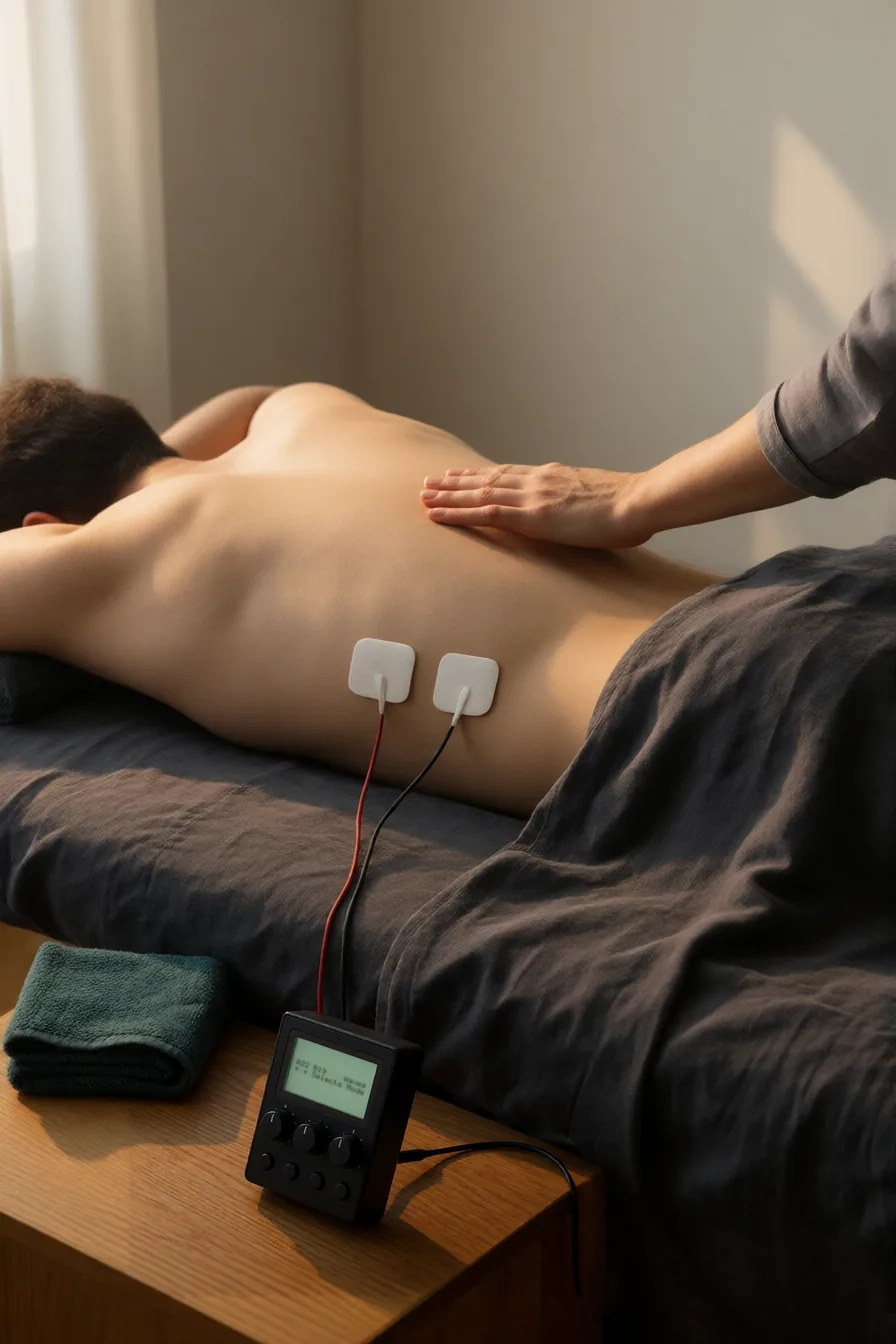
The legs and hips are safe from the four rules and still carry local contraindications worth knowing.
Clots. A deep vein thrombosis is a clot in a deep leg vein. Its dangerous complication is a piece breaking loose and lodging in the lungs. Massage to a leg with a known clot is avoided for exactly that reason, and leg massage has been implicated in past cases.2 Now consider what a muscle contraction is: a pump. Squeezing the calf or thigh around a clot is the last thing you want, whether the squeeze comes from a forearm or from a pad. The screening is the same. Swelling in one leg but not the other, warmth, redness or discoloration, pain or tenderness, especially after a long flight, a surgery, a pregnancy, or a stretch of immobility: no massage there, no stimulation there, and a conversation with a clinician first.
Varicose veins. Bulging superficial veins with failed valves. Massage over them is light, or skipped if it hurts, with the leg raised so gravity helps drain it. Pads do not belong on top of them.
Bruises. A fresh bruise is leaked blood in the tissue. It is off limits until it has started turning greenish yellow, usually four to seven days in. Note that this color shift is hard to read on darker skin; when in doubt, wait longer.
Skin is the contract
Everything your masseuse does passes through skin, so skin gets its own section.
Skin is the body's largest organ and one of its best defenses: a self-repairing barrier with a slightly acidic film of oil and sweat that discourages microbes, a dense field of pressure and temperature sensors, and a limited but real ability to absorb what is put on it (medicated patches work because of this). It also reports on the inside. Flushing, pallor, heat, swelling, and texture are all things a therapist reads before touching.
Three skin facts matter most for hydrogel pads.
First, broken or inflamed skin concentrates current. A pad over a scratch, a pimple, a rash, a sunburn, or a healing scar is not a minor discomfort; it is a small area receiving what was meant to spread over a large one. Every such spot is a local contraindication. Scars are off limits until they are dry and fully into remodeling, which is two months or more.
Second, skin reacts to what touches it. Contact dermatitis is inflammation where an irritant or allergen met the skin; it shows up within minutes to hours and can last weeks. Four out of five cases are simple irritation rather than true allergy.1 Adhesives are a common trigger. The practical response is the one therapists use for lotions and linens: watch for a reaction, rotate placement so the same patch of skin is not asked to tolerate the same adhesive session after session, and treat a persistent red rectangle as a reason to stop, not to push through.
Third, preparation is most of the game. Therapists who apply elastic therapeutic tape follow a routine that translates directly to pads: clean, dry, lotion-free skin; an alcohol wipe if needed; trim hair where it prevents contact; press the pad down firmly so it seats evenly; and when it comes off, peel slowly in the direction the hair grows. A patchy, half-lifted pad is the most common cause of a sharp or stinging sensation, because the current is crowding through the part still touching.
Before every session: the two-minute screen
A licensed therapist runs this in their head at every intake. Run it yourself.
- Fever, or feeling like you are coming down with something? Not today.
- Anything new on the skin below the waist: rash, cut, boil, bruise, unexplained lump? Not there.
- One leg swollen, warm, or tender and the other not? Not there, and call someone who can examine it.
- Recent surgery, injury, or a scar less than a couple of months old in the area? Not there.
- Pacemaker, defibrillator, or any implanted stimulator, anywhere in the body? Not without your physician.
- A medicated patch nearby? Leave a wide margin.
- Are you propped up where the camera can see you, so your masseuse can watch for a brace, a gasp, or a change in heart rate and back off before you have to say anything? Good. Start from zero.
Where the current never goes
masseuse.ai works below the waist, on intact skin, through hydrogel pads. Four rules are absolute:
- Never place pads across the chest or upper back so that current could cross the heart.
- Never stimulate the throat or the carotid sinus at the side of the neck.
- Never place pads across the head or temples.
- Not for anyone with a pacemaker, an implantable cardioverter-defibrillator, or an active neurological implant, unless a physician is supervising.
Start from zero and ramp up. Stop at the first sharp, stinging, or burning sensation.
References
- Salvo SG. Massage Therapy: Principles and Practice. 7th ed. Elsevier; 2024. Chapters 8 (endangerment sites and contraindications), 22 (skin), and 26 (the heart's conduction system and vascular conditions). Publisher
- Ernst E. The safety of massage therapy. Rheumatology (Oxford). 2003;42(9):1101-1106. doi:10.1093/rheumatology/keg306 · PubMed
- Posadzki P, Ernst E. The safety of massage therapy: an update of a systematic review. Focus Altern Complement Ther. 2013;18(1):27-32. doi:10.1111/fct.12007
- Digby GC, Daubney ME, Baggs J, et al. Physiotherapy and cardiac rhythm devices: a review of the current scope of practice. Europace. 2009;11(7):850-859. doi:10.1093/europace/eup102 · PubMed
masseuse.ai writes about wellness, not medicine. Nothing here diagnoses or treats a condition. If you have a health concern, talk to a clinician who can examine you.