Massage Therapy, Reconsidered · Part 4
The Rest Beat: Why Letting Go Costs Energy, and What That Means for a Duty Cycle
A muscle needs fuel to relax, not just to contract. That single fact explains trigger points, the blanch-and-flush of a held thumb, and why masseuse.ai spends half of every session doing nothing on purpose.
By masseuse.aiUpdated 10 mins read
Here is a fact that rearranges how you think about tension: a muscle needs energy to relax.
Most of us carry the opposite picture. Contracting is the effort, relaxing is what happens when the effort stops, the way a stretched rubber band goes slack the moment you let go. Muscle does not work like that. Inside every fiber, letting go is an active step with a fuel cost, and when the fuel runs short the muscle does not go slack. It stays shut.
That one fact explains why a knot forms, why a therapist's thumb held on a sore spot turns the skin white and then pink, why a muscle that has been clenched all day feels like it belongs to someone else, and why masseuse.ai spends roughly half of every session deliberately doing nothing. This post walks through the physiology in plain terms and then shows how it becomes a design rule.
What actually happens when a muscle lets go
Zoom in far enough and a muscle fiber is a bundle of overlapping filaments: thick ones studded with tiny hinged heads, thin ones with docking sites along their length. A nerve signal arrives and the fiber floods with calcium. Calcium uncovers the docking sites, the heads grab on, and each one pivots, hauling the thin filament a fraction of a step inward. The fiber shortens. That pivot is contraction, and it is what people picture when they picture a muscle working.1,2,3
Now the part almost nobody pictures. A head that has pivoted is still holding on. To release its grip, reset its hinge, and get ready for another pull, it needs a molecule of the cell's energy currency, adenosine triphosphate, ATP for short. No ATP, no release. At the same time, the calcium that started everything has to be pumped back into storage so the docking sites close again, and those pumps run on ATP too.
So relaxation is two energy-consuming jobs: unhook every head, and clear the calcium. The textbook proof is grim but memorable. After death, cells stop making ATP, the heads cannot let go, and the body stiffens. Rigor mortis is muscle that has lost the ability to relax because it has lost the fuel to do it. A living muscle in an energy shortfall is a much milder version of the same thing.
Where the fuel comes from, and how fast it runs out
Muscle keeps very little ATP on hand. What is there gets used within seconds, and the fiber has to make more continuously from glucose. It has two ways to do that.
The first needs no oxygen and starts the instant the muscle begins working. It is fast and it is stingy: about two ATP per glucose, and it can carry the load for perhaps thirty to sixty seconds before its acidic byproducts pile up. The second needs oxygen and happens inside the mitochondria, the little power plants scattered through every fiber. It is slow to spin up and enormously more productive: on the order of thirty-six ATP per glucose. It runs as long as oxygen keeps arriving.1
Read that again with a stopwatch in mind. A muscle that contracts hard and continuously is living on the stingy pathway for the first minute and going into debt. The productive pathway needs oxygen, and oxygen arrives by blood, and here is the catch: a contracting muscle squeezes its own blood vessels shut. It is a sponge wringing itself out. Blood, and the oxygen and glucose it carries, flows back in when the muscle releases. Which it cannot fully do without ATP. Which it cannot make without oxygen.
You can see the loop closing.
The knot as an energy crisis
That loop is the leading explanation for trigger points, the tender, pea-sized spots in a tight band of muscle that refer pain elsewhere and make you flinch when pressed. The account goes like this. Strain, overuse, or a blow triggers a patch of fibers into sustained contraction. The contraction pinches off local blood flow. Oxygen and glucose stop arriving, ATP runs down, and the heads in that patch cannot let go. The starved tissue releases irritant chemicals that make the spot hurt and that, in turn, keep it contracted. A small region of muscle has locked itself into a self-sustaining energy crisis.4,5,6
This is why trigger points do not respond to being told to relax. The fibers are not stubborn. They are broke.
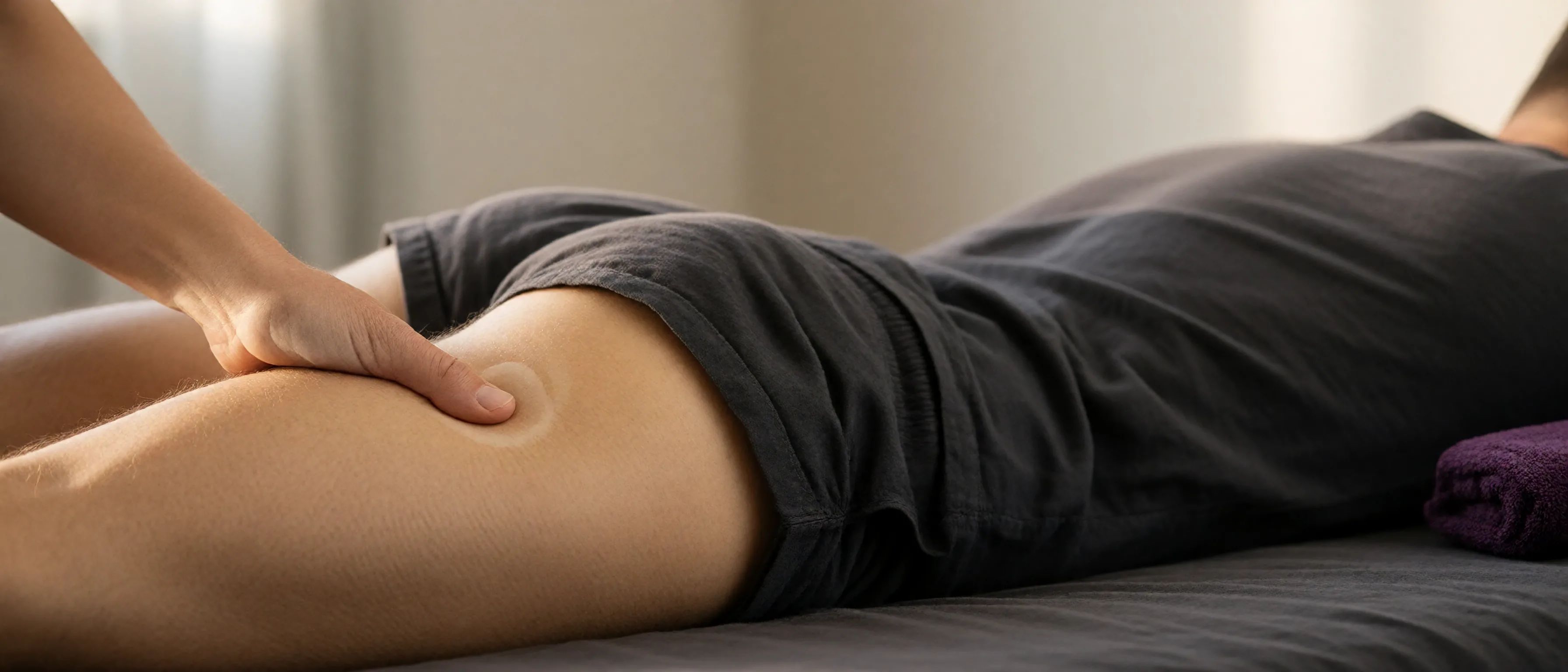
It is also why the classic manual treatment works the way it does. A therapist presses a trigger point and holds, ten to twenty seconds, at a pressure that is uncomfortable but not sharp.7 The skin under the thumb blanches white: pressure has pushed the blood out. Then the thumb lifts and the spot flushes pink: blood floods back in, faster and fuller than before. The old name for this move was ischemic compression, after the blanching, but the therapy is not in the squeeze. It is in the release. The squeeze is a way of guaranteeing a big, fresh inflow afterward, and the inflow is what buys the fibers enough ATP to finally let go.
Hold that idea: the therapeutic moment is the rest.
Motor units, recruitment, and the case for the ramp
One more piece of physiology, because it turns into a second design rule.
A muscle is not one thing that contracts a little or a lot. It is thousands of fibers organized into teams, each team wired to a single nerve cell. A team either fires fully or not at all; there is no partial contraction at that level. The body varies force by varying how many teams it calls, a few for lifting a pencil, many for lifting a book. The process of calling more teams as more force is needed is called recruitment, and it is gradual by design.
A skilled therapist mirrors this from the outside. Pressure sinks in over a couple of seconds, never plunges, so the tissue has time to accept it and the nervous system has no reason to brace. A sudden jab, even at a pressure that would be fine if arrived at slowly, produces a flinch and a guarding contraction, and now the therapist is fighting the very tension they came to reduce.
Electrical stimulation recruits teams too, in a rough electrical analog of what the nerve does, and it can recruit them all at once if you let it.8 That is the electrical version of the jab. The alternative is the ramp: intensity climbing from nothing over a few seconds, so the muscle comes on smoothly, and falling away over a few seconds at the end of each contraction, so it comes off smoothly. A ramp is not a comfort feature bolted onto a stimulation pattern. It is how a nervous system expects force to arrive.
Two rules, one session
Put the two ideas together and you have the shape of a well-built electro-massage.
Rule one: work, then rest, and make the rest count. The contraction phase is short, comfortably inside the window where the fast fuel pathway can cover it. The rest phase that follows is at least as long, and early in a session often two or three times as long, because rest is when blood returns, mitochondria get oxygen, and the fibers rebuild the ATP they need to release completely before the next round. The ratio of on-time to off-time is the duty cycle, and a low one is not a weak setting. It is a session that respects where the fuel comes from.
Rule two: never arrive suddenly. Each contraction ramps up and ramps down. The session as a whole does the same, starting from nothing, building over minutes, and easing out at the end, exactly the slow-to-specific-to-slow arc a therapist follows with hands.
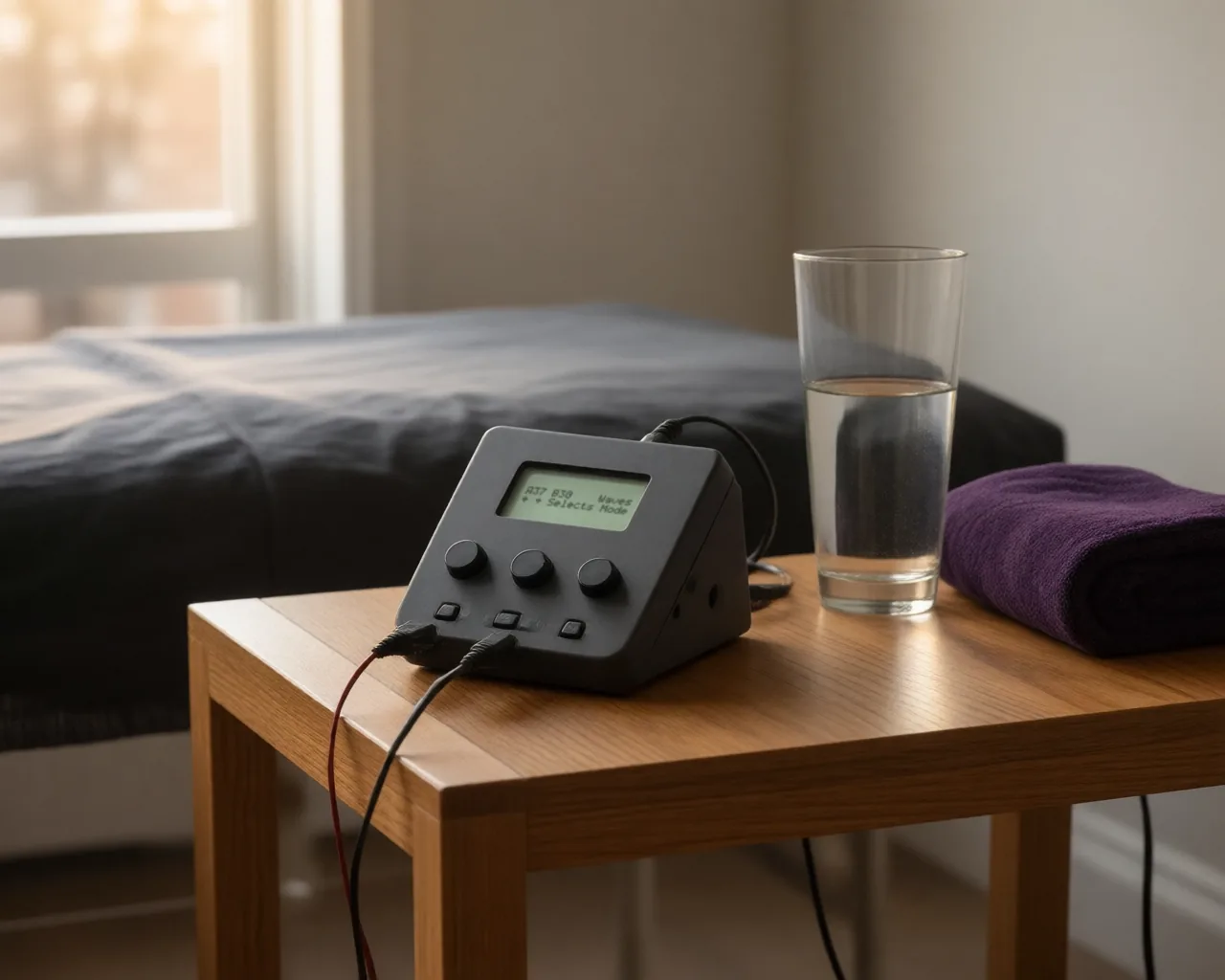
Your masseuse runs on these rules, and it has one advantage over a stopwatch: it can see whether the rest actually happened. The camera watches the muscle under the pads through the whole cycle. In the work phase it should see a clench; in the rest phase it should see that clench dissolve. When the muscle is still visibly tight partway into a rest window, that is the tissue reporting that it did not have the fuel to let go on schedule. The response is the one a therapist would make with a thumb: longer rest, gentler work, and no pressing on. A heart rate that drifts upward across the session is read the same way, as fatigue accumulating, and the duty cycle stretches out to match.
There is a name for what goes wrong when you skip this. Physiologists define fatigue narrowly, as a drop in the force a muscle can produce, and trace it to a short list of causes: the nerve stops driving the fiber, or the fiber runs low on fuel, whether ATP, the glucose to rebuild it, or the oxygen to do so efficiently.9 A stimulation pattern with too little rest reaches fatigue fast, and a fatigued muscle is a muscle that has stopped letting go. That is the opposite of a massage.
A note on which muscles you are working
Fibers come in two broad types. Slow fibers are dark red, packed with mitochondria and capillaries, built for long, steady, low-force work, and hard to tire. Most of the muscles that hold you upright are made of them. Fast fibers are paler, sparser in mitochondria, quicker and stronger, and quick to exhaust. The muscles of the pelvic floor, the ones your masseuse cares about most, lean heavily toward the slow, postural type: they are on duty all day holding things in place, which is exactly why they end up in low-grade sustained contraction and exactly why they respond to being cycled through deliberate work and deliberate rest. But slow does not mean tireless. The rest beat applies to them as much as to anything.
What you might feel afterward, and what it means
Massage produces next-day soreness in roughly one client in ten, typically starting about half a day later and gone within a day or two.10 Exercise physiology has a parallel: delayed-onset muscle soreness begins the day after unfamiliar work and peaks around forty-eight hours.11 Both are the mild, self-limiting cost of tissue that did more than it was used to. A little heaviness the morning after a session is in that category. Sharp pain, pain that worsens past two days, bruising, or soreness that arrives during the session rather than after it is not, and each is a reason to stop and reassess before the next one.
Where the current never goes
masseuse.ai works below the waist, on intact skin, through hydrogel pads. Four rules are absolute:
- Never place pads across the chest or upper back so that current could cross the heart.
- Never stimulate the throat or the carotid sinus at the side of the neck.
- Never place pads across the head or temples.
- Not for anyone with a pacemaker, an implantable cardioverter-defibrillator, or an active neurological implant, unless a physician is supervising.
Start from zero and ramp up. Stop at the first sharp, stinging, or burning sensation.
References
- Salvo SG. Massage Therapy: Principles and Practice. 7th ed. Elsevier; 2024. Chapters 20 (the sliding-filament model, energy sources, and fiber types) and 14 (the integrated hypothesis of trigger point formation). Publisher
- Huxley AF, Niedergerke R. Structural changes in muscle during contraction: interference microscopy of living muscle fibres. Nature. 1954;173(4412):971-973. doi:10.1038/173971a0 · PubMed
- Huxley H, Hanson J. Changes in the cross-striations of muscle during contraction and stretch and their structural interpretation. Nature. 1954;173(4412):973-976. doi:10.1038/173973a0 · PubMed
- Simons DG. Review of enigmatic MTrPs as a common cause of enigmatic musculoskeletal pain and dysfunction. J Electromyogr Kinesiol. 2004;14(1):95-107. doi:10.1016/j.jelekin.2003.09.018 · PubMed
- Gerwin RD, Dommerholt J, Shah JP. An expansion of Simons' integrated hypothesis of trigger point formation. Curr Pain Headache Rep. 2004;8(6):468-475. doi:10.1007/s11916-004-0069-x · PubMed
- Shah JP, Danoff JV, Desai MJ, et al. Biochemicals associated with pain and inflammation are elevated in sites near to and remote from active myofascial trigger points. Arch Phys Med Rehabil. 2008;89(1):16-23. doi:10.1016/j.apmr.2007.10.018 · PubMed
- Simons DG, Travell JG, Simons LS. Myofascial Pain and Dysfunction: The Trigger Point Manual. Vol 1: Upper Half of Body. 2nd ed. Williams & Wilkins; 1999. WorldCat
- Maffiuletti NA. Physiological and methodological considerations for the use of neuromuscular electrical stimulation. Eur J Appl Physiol. 2010;110(2):223-234. doi:10.1007/s00421-010-1502-y · PubMed
- Allen DG, Lamb GD, Westerblad H. Skeletal muscle fatigue: cellular mechanisms. Physiol Rev. 2008;88(1):287-332. doi:10.1152/physrev.00015.2007 · PubMed
- Cambron JA, Dexheimer J, Coe P, Swenson R. Side-effects of massage therapy: a cross-sectional study of 100 clients. J Altern Complement Med. 2007;13(8):793-796. doi:10.1089/acm.2006.6401 · PubMed
- Cheung K, Hume P, Maxwell L. Delayed onset muscle soreness: treatment strategies and performance factors. Sports Med. 2003;33(2):145-164. doi:10.2165/00007256-200333020-00005 · PubMed
masseuse.ai writes about wellness, not medicine. Nothing here diagnoses or treats a condition. If you have a health concern, talk to a clinician who can examine you.