Massage Therapy, Reconsidered · Part 2
The Six Strokes, and the Seventh: What Electricity Can and Cannot Imitate
Every massage is built from six techniques and five kinds of force. Here is what each one does, and an honest account of which ones electro-massage can reproduce.
By masseuse.aiUpdated 9 mins read
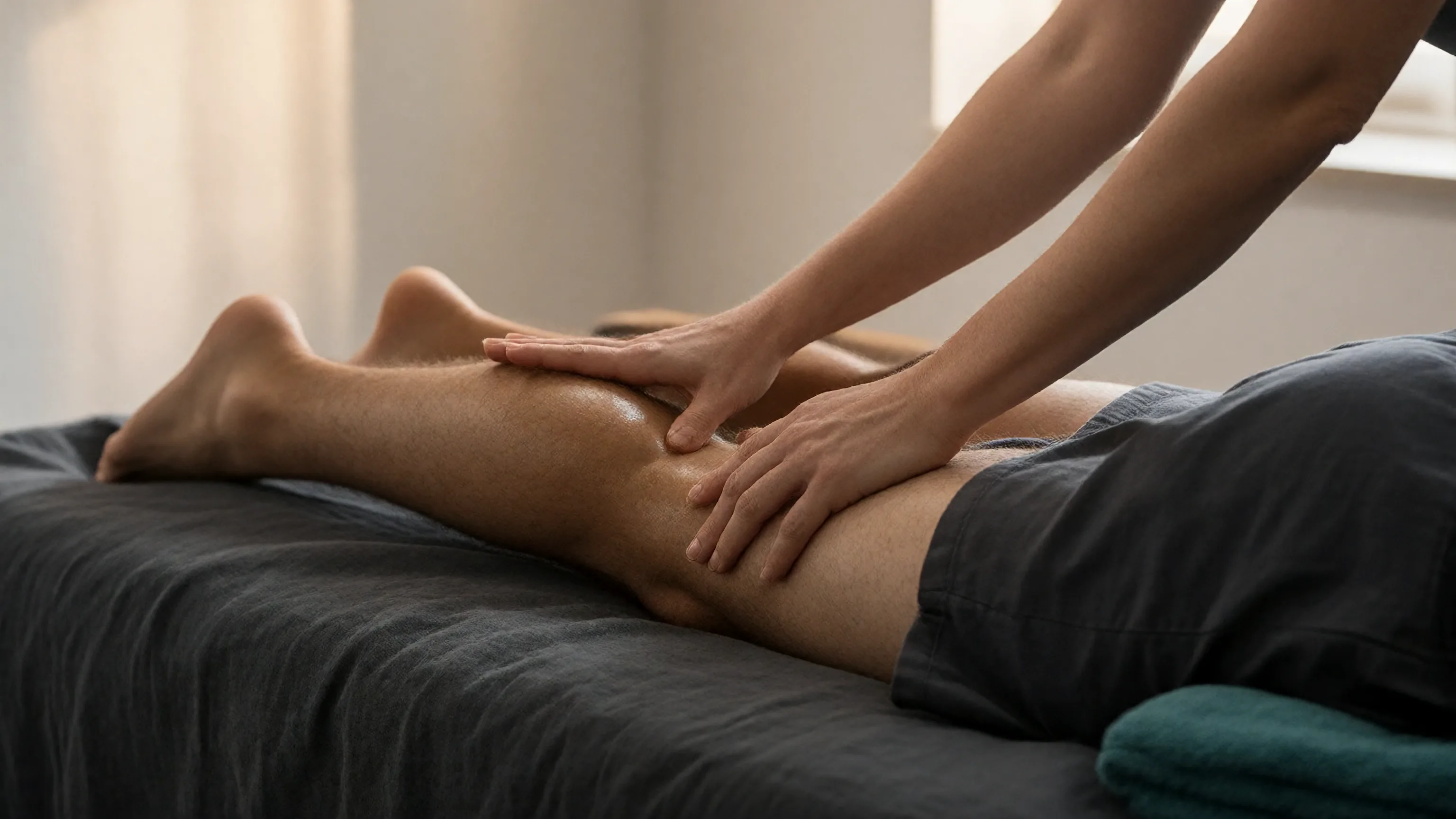
Every massage you have ever had, from the hotel spa to the sports clinic, was assembled from the same six building blocks. They have French names because French was the language of medicine when they were named, and they have stuck for two centuries because the categories are genuinely useful. Once you know them you can watch a session the way a musician listens to a song: not as a wash of sensation but as a sequence of choices.
This post walks through the six, then asks a question the textbooks do not: where does electrical muscle stimulation fit? We build a product around it, so we have an interest in the answer. We also have an interest in the answer being true, which is why the honest version includes a list of things electricity cannot do.
First, the forces
Underneath the six techniques are five physical forces a hand can put into tissue.1 Knowing them makes the techniques easier to understand.
- Compression pushes tissue toward bone.
- Tension pulls tissue longer, as in a stretch.
- Bending squeezes and lifts at once, curving tissue into a C shape.
- Shear slides one layer across another.
- Torsion twists.
Any stroke is a recipe of one or more of these, and the recipe determines what the stroke can accomplish. Compression moves fluid and quiets nerves. Tension lengthens. Shear generates heat and can help remodel scar tissue. Bending and torsion pry layers apart from each other. Keep this list in mind; we will come back to it.
Effleurage: the glide
Effleurage is gliding. Long, contoured strokes that follow the shape of the body, heavier on the way toward the heart and lighter on the way back. It opens a session, closes it, spreads lubricant, and bridges between everything else. It is also the therapist's radar: a slow glide down a back tells experienced hands where the tight bands are before any specific work begins.
Variations are mostly about hands: one, two, stacked for depth, the forearm for a broad heavy pass, or hands alternating so that one is always touching. At the far light end sits a barely-there fingertip trail down the body, which some schools call feathering. It has a catch: done quickly, very light touch tickles or raises goose bumps and pushes the nervous system toward alert rather than calm. Slow is the whole trick.
Force profile: almost pure compression, applied in motion.
Petrissage: the knead
Petrissage lifts. Grasp, lift away from the bone, squeeze, release, and move on, either with one hand, two hands together, two hands alternating, or two hands pulling tissue in opposite directions in a broad wringing motion. The shallow version works skin and the layer just beneath; the deep version takes hold of a whole muscle belly.
Skin rolling belongs here too: gather a fold of skin between fingers and thumbs and walk it along the surface, the fold traveling ahead of the thumbs, in several directions, because the loose connective tissue under the skin is not laid out in neat rows. It can be uncomfortable, so it starts light.
Force profile: bending and torsion, with compression at the squeeze. This is the family that pries layers apart.
Friction: the rub
Friction rubs, with pressure equal in every direction, which is exactly what distinguishes it from effleurage. Superficial friction glides briskly over the skin to warm it: back-and-forth palms, a sawing edge of the hand, a towel. Deep friction does not glide at all. The hand takes the skin with it and moves skin and hand as one unit over the tissue below, so the force lands on tendon and ligament. Done across the grain of the fibers it is called transverse or cross-fiber friction; done along the grain it is called chucking; done in small circles around a joint it is circular.
Deep friction is the technique for old injuries. It produces heat, may stir up a small and deliberate amount of inflammation, and is credited with breaking up adhesions and helping scar tissue reorganize along useful lines.2,3
Force profile: shear, the layer-against-layer slide.
Compression: the press
Compression presses without gliding. Held compression parks on one spot for ten to twenty seconds, long enough for the skin to blanch and then flush pink when released, which is why the older name for it was ischemic compression. It is the core move of trigger point work.4 Pulsed compression is the same press repeated in a steady cadence, usually with a broad tool on a big muscle: sink in, ease off, sink in again. On a relaxed body the whole person starts to sway, and a good therapist times each press to the return of the sway so the rhythm feeds itself.
Rate changes everything. Fast, closely spaced compressions stimulate. Slow, widely spaced ones calm.
Force profile: compression, either held or pulsed.
Tapotement: the strike
Tapotement is percussion, and it comes in as many flavors as there are ways to land a hand. Fingertips drumming lightly, the way you drum on a desk while thinking. Fingers and thumbs catching small folds of skin and letting them go. The edges of the hands chopping in quick alternation. Palms loosely cupped so that each strike lands with a hollow sound instead of a slap, timed to the exhale, which is also how respiratory therapists loosen mucus in the lungs. Loose fists, open palms, a relaxed hand laid on the body and struck through with the other.
Light percussion calms and suits the face and scalp. Vigorous percussion stimulates and belongs on the back, hips, thighs, and calves. It stays away from the kidneys, and it is never the closer: a session ends with slow strokes, not drumming.
Force profile: compression, delivered as impulses.
Vibration: the shake
Vibration trembles. Fine vibration keeps the hand in contact and shudders it, sometimes while lifting the tissue slightly. Jostling grabs a limb or a muscle and shakes it, often with a little traction at the joint above so the whole thing loosens. Fluffing lifts and drops a limb gently while the joint is held long.
Here is a historical footnote that matters for the rest of this post: vibration is the one technique where the standard curriculum already accepts a machine. Handheld electric vibrators are taught alongside the manual version, with sensible rules attached: keep them off bony prominences, limit them to a few minutes because prolonged use irritates, and mind the cord. The profession did not reject the machine. It gave it a place and a set of rules.1
Force profile: compression, oscillating.
The seventh: contraction from the inside
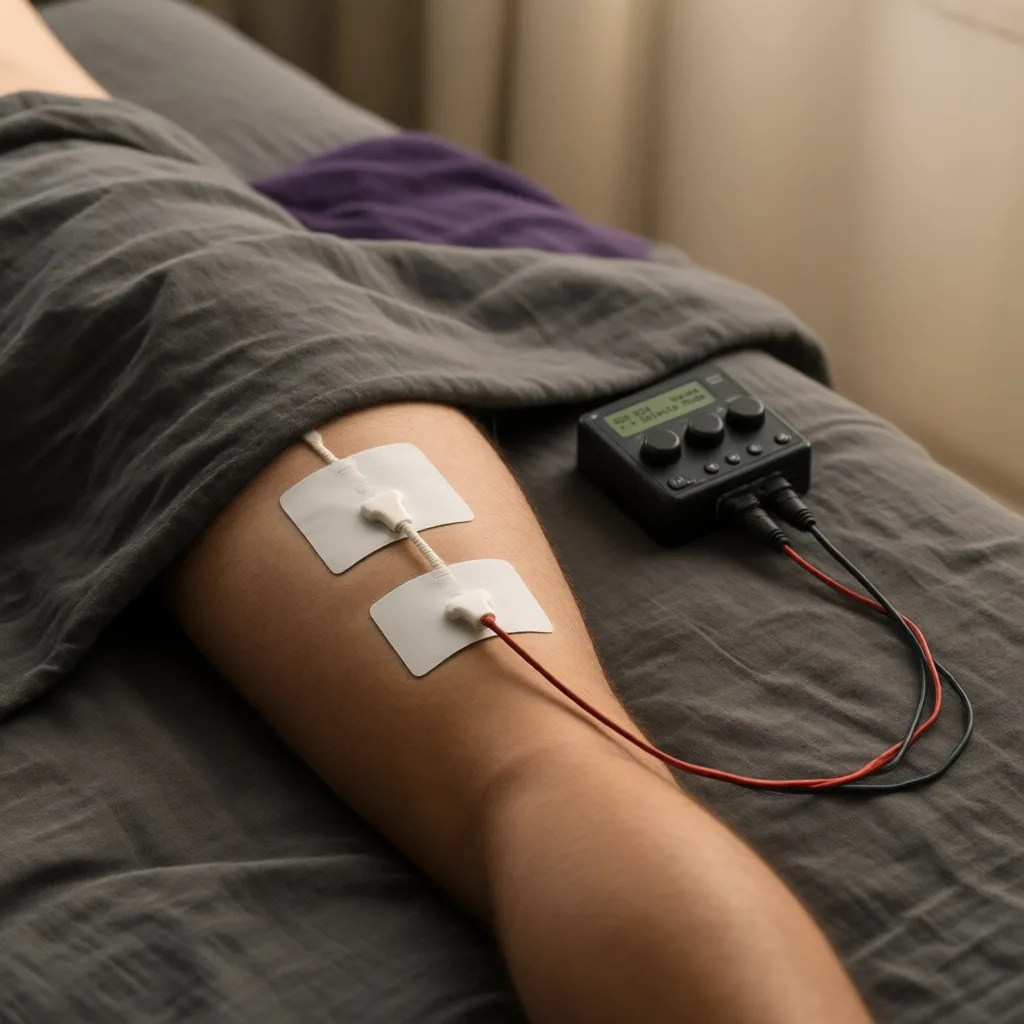
Now the question. Neuromuscular electrical stimulation, delivered through hydrogel pads on the skin, causes the muscle under the pads to contract and then release. Where does it fit among the six?
Look at the force profiles and the answer is clear. Six techniques put force into the body from outside; four of them are variations on compression. Electrical stimulation is the only approach that generates force inside the tissue. The muscle squeezes itself. Every contraction compresses the vessels running through the muscle and then releases them, which is the body's own pumping mechanism, the thing rhythmic compression from a forearm is trying to imitate from the outside. In that sense the seventh technique is not a poor copy of the fourth. It is closer to the original.
What can a stimulation pattern reproduce?
- Rhythmic compression, almost exactly. A steady pulse of contract-and-release at a chosen cadence is the internal twin of the heel-of-hand pump, complete with the rule that fast is stimulating and slow is calming.
- The rate and rhythm rules of effleurage. Slow rolling patterns that swell and fade behave like long strokes: they begin the session, they carry the middle, they end it. masseuse.ai follows the same convention a therapist does, starting from nothing and ramping gently, holding a steady rhythm through the body of the session, and easing back out rather than stopping cold.
- Vibration, at higher pulse rates that feel like a hum rather than a squeeze.
- Sustained compression, when a contraction is held for several seconds before release, which brings us to the one thing the seventh technique needs that a hand does not: a rest beat. A muscle asked to hold without pause runs short of the fuel it needs to let go. Every pattern your masseuse runs is built as work followed by rest, and the rests are not filler; they are where the muscle recovers the ability to relax. That gets its own post.
What can it not reproduce? Be honest here.
- Tension. Electricity shortens muscle; it cannot lengthen it. There is no stretch in a stimulation pattern. Stretching is your job or a partner's, and a later post covers how to pair the two.
- Bending and torsion. Nothing in a contraction lifts skin away from muscle or twists a fold of tissue. Skin rolling, wringing, and the layer-prying family stay manual.
- Shear. Cross-fiber friction on a stubborn tendon is a hand skill. A contraction does not slide one layer across another.
- Palpation. A therapist finds the tight band by feel. Your masseuse cannot feel anything. It compensates with sight: the camera watches the muscle under the pads clench and release, so it knows the contraction it asked for actually happened, how strong it looked, and whether the rhythm is holding. That is the closest a machine gets to a hand on the tissue, and it is why the camera is not optional.
So the seventh technique is real, it is narrower than the six, and it is strongest exactly where the six are weakest: sustained, evenly timed, internally generated contraction that never gets tired and never loses the beat. Used for what it is good at, alongside hands for the rest, it earns its number.
Reading a session like a musician
Next time you are on a table, notice the sequence. Slow glides to start. Kneading once the tissue is warm. Specific rubbing or holding on the spots that need it. Perhaps a little percussion to wake a heavy leg. Shaking to loosen a limb. Slow glides to finish. That arc, slow to specific to slow, is the shape of a good session, and it is the shape your masseuse follows too, in a language of contractions instead of strokes.
Where the current never goes
masseuse.ai works below the waist, on intact skin, through hydrogel pads. Four rules are absolute:
- Never place pads across the chest or upper back so that current could cross the heart.
- Never stimulate the throat or the carotid sinus at the side of the neck.
- Never place pads across the head or temples.
- Not for anyone with a pacemaker, an implantable cardioverter-defibrillator, or an active neurological implant, unless a physician is supervising.
Start from zero and ramp up. Stop at the first sharp, stinging, or burning sensation.
References
- Salvo SG. Massage Therapy: Principles and Practice. 7th ed. Elsevier; 2024. Chapter 8 (the six techniques and the physical forces behind them). Publisher
- Cyriax JH. Textbook of Orthopaedic Medicine. Vol 2: Treatment by Manipulation, Massage and Injection. 11th ed. Baillière Tindall; 1984. WorldCat
- Chamberlain GJ. Cyriax's friction massage: a review. J Orthop Sports Phys Ther. 1982;4(1):16-22. doi:10.2519/jospt.1982.4.1.16 · PubMed
- Simons DG, Travell JG, Simons LS. Myofascial Pain and Dysfunction: The Trigger Point Manual. Vol 1: Upper Half of Body. 2nd ed. Williams & Wilkins; 1999. WorldCat
masseuse.ai writes about wellness, not medicine. Nothing here diagnoses or treats a condition. If you have a health concern, talk to a clinician who can examine you.