Massage Therapy, Reconsidered · Part 1
Attention Is All You Knead: What a Great Massage Therapist Actually Pays Attention To
The best therapists read a body, not a checklist. What they watch for, why pressure is the wrong thing to brag about, and how masseuse.ai learned the same habits.
By masseuse.aiUpdated 8 mins read
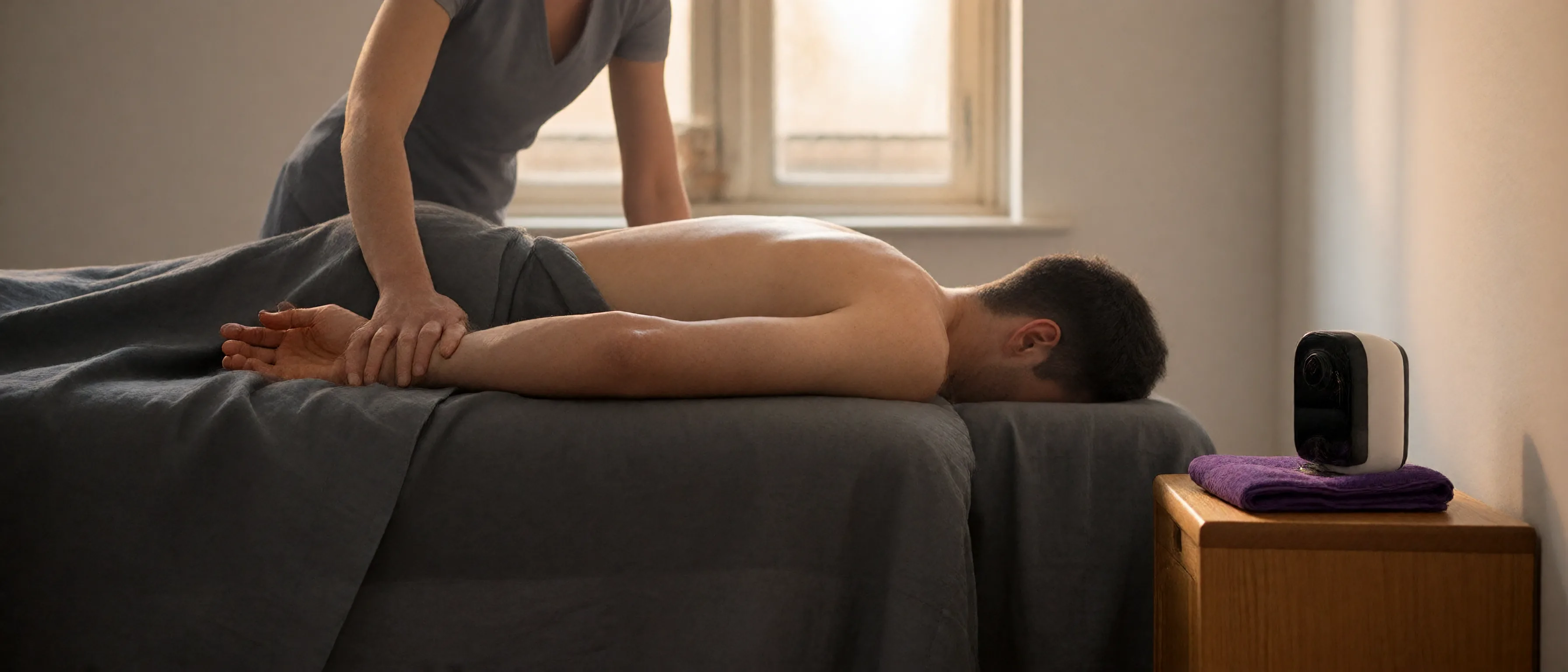
Ask people what made the best massage of their life so good and they will usually say something about pressure. "She really got in there." "He found the spot." Pressure is the part you can feel, so it gets the credit.
Ask a good therapist what made that session good and you get a different answer. They will talk about the moment your breathing changed. The half-second your shoulder braced before they eased off. The way your voice softened three minutes in. They were not pressing harder than the last person. They were paying closer attention.
That is the thesis of this whole series, and it is baked into our name. Attention is all you knead.
The skill has a name: tracking
Massage education has a word for this, and it is a surprisingly plain one: tracking. In the standard training texts, tracking is the ability to notice what a client is experiencing from moment to moment and to change your work in response.1 It is taught alongside the strokes themselves, which tells you how the profession ranks it. You do not learn to press; you learn to press while watching.
What is a therapist watching? A surprisingly consistent list:
- The face. A squint or a tightening around the eyes arrives before anyone says "that's too much."
- The breath. Face-down, the breath shows in the lower back rising and falling. Face-up, it shows in the belly. When the breath goes shallow or stops, the body has stopped consenting to the pressure even if the person has not said so.
- The flinch. A small withdrawal from a stroke applied too fast or too hard. Not dramatic. Easy to miss if you are looking at your own hands.
- The voice. Not the words, the tone and cadence. People hum differently when they are relaxing than when they are enduring.
- The extremities. Hands curling, feet clenching, toes gripping the sheet. The body braces at the edges first.
- The tissue itself. Under the therapist's hand, the muscle either softens or hardens as a new technique begins. Hardening is a vote against.
Notice what is not on the list: the client's verbal report. Words matter and a therapist asks for them, but words lag. By the time someone forms the sentence "could you go a bit lighter," their jaw has been set for thirty seconds. The involuntary signals are faster and more honest, which is why the profession trains people to watch them.
The pressure paradox
Here is the part that surprises most first-time clients. When researchers ask massage recipients to rate the pressure they prefer on a ten-point scale, the answer clusters around six or seven. Not ten. Not "as deep as you can go." Firm, unhurried, and clearly under the threshold where it starts to hurt.
The three broad bands of pressure are worth knowing, because they map to what the therapist is doing with their own body:
- Light (roughly 0 to 3). Nothing more than the weight of a relaxed hand resting on you. The skin barely shifts. This is how sessions open and close, how oil goes on, and how a therapist handles anywhere fragile.
- Moderate (roughly 4 to 7). Now the therapist is lending you some of their own body weight, and you can feel the outer layer of muscle move under the skin, along with its fascia, the connective wrapping that sheathes it. This is the band most people mean by "a good massage," and it is the band with the best evidence for calming the nervous system.2,3
- Deep (roughly 8 to 10). Smaller, harder tools and more weight behind them, aimed toward bone. Useful in specific hands for specific goals. Also the band most associated with soreness afterward and, over vulnerable areas, with actual injury.
The physiology behind the moderate band is the interesting bit. Moderate pressure appears to shift the nervous system toward its "rest" setting by way of the vagus nerve, which is the main highway of the parasympathetic system.3 Downstream of that shift you see more oxytocin and less cortisol. Light, fast, feathery touch does the opposite: it can nudge the body toward alertness.2 So the popular idea that gentler is always more relaxing is wrong, and so is the idea that harder is always more therapeutic. There is a middle, and the middle is where the body votes yes.
The working rule is simple to state and hard to follow: press hard enough that tension drops, and never so hard that the body manufactures more of it. Painful massage produces guarding and spasm, which is the opposite of what anyone came in for.
Rhythm is a form of kindness
Two more things a skilled therapist controls, and both are about predictability.
Rate. Slow strokes calm; quick strokes stimulate. Long gliding strokes are applied slowly; kneading, rubbing, and percussion are applied faster. A session starts slow and ends slow, and the slow strokes double as reconnaissance, telling the therapist where the tissue is tight before anything specific is attempted.
Rhythm. Regular, evenly spaced repetitions are preferred over irregular ones, for a simple reason: the body can anticipate them. There is even a convention of repeating a technique in multiples of three. The first pass is novel and the nervous system treats it as new information. The second pass is recognized. By the third pass the stroke is predictable, and predictability is what lets a person stop monitoring and start relaxing.
I think this is the most underrated idea in bodywork. Relaxation is not the absence of stimulus. It is the presence of a stimulus the body has decided it does not need to watch.
What this looks like when the therapist is software
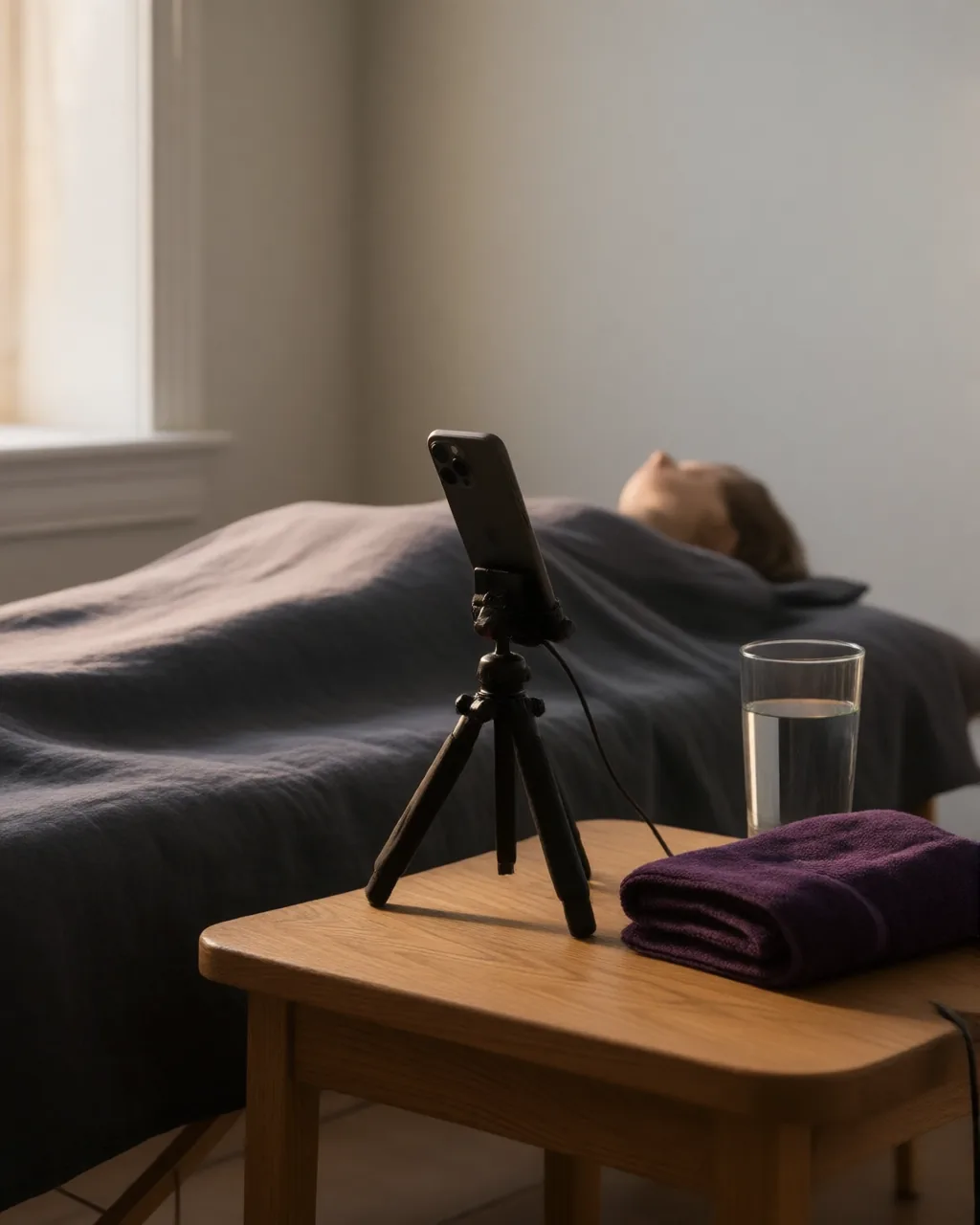
masseuse.ai was built around the tracking list above, and it is worth being concrete about what it can and cannot do.
It can see you. From your phone's camera it draws a skeleton over your body and holds it there while you move, so it knows where your hips are relative to your feet, whether you are still or shifting, whether you have propped yourself up or gone flat. Posture is the first tracking cue, and it is the one a camera is genuinely good at.
It can watch the muscle itself. Below the waist, the camera can see the difference between a glute that is clenched and one that has let go, how often the clenches come, and whether they are steady or scattered. A therapist feels this under the hand; your masseuse reads it from the surface.
It can listen. Sighs, groans, gasps, changes in breathing. These are the vocal cues from the tracking list, treated as signals rather than as words.
It can read your heart. Heart rate at rest before anything starts becomes a baseline; the direction it moves afterward is a second opinion on everything the camera and microphone are saying.
And it can act on what it sees, because in place of hands it uses a purpose-built neuromuscular electrical stimulation unit, connected to you through hydrogel adhesive pads. The stimulation makes the muscle contract and release from the inside, the way a good kneading stroke would from the outside. What the therapist does with pressure, your masseuse does with intensity: it starts from nothing and ramps up slowly, holds where the body is saying yes, and eases off the moment a gasp, a brace, or a climbing heart rate says otherwise. It also builds in rests, because a muscle that is asked to contract without pause runs short of the fuel it needs to let go again. More on that in a later post.
What it cannot do is feel. There is no substitute for a trained hand noticing that the tissue under it just hardened. Your masseuse compensates by watching more channels at once than any human can and by never getting bored, distracted, or tired at the end of a long day. Different strengths. The same discipline: attention first, force second.
Try this at your next massage, human or otherwise
- Before the session, say your number. "I like about a six out of ten" is more useful to a therapist than "medium."
- Notice your own hands and feet. If they are curled, the pressure is too much, whatever your mouth is saying.
- Breathe on purpose for the first minute, then stop managing it and see where it goes. If it stays slow and low, you are getting what you came for.
- Expect a little soreness the next day about one time in ten. It typically shows up around twelve hours later and fades within a day or two.4 Anything sharper, longer, or accompanied by bruising is worth mentioning.
- If you are using masseuse.ai, prop the phone where it can see your whole body, confirm you see your skeleton, and then forget about it. The whole point is that it is watching so you do not have to.
Where the current never goes
masseuse.ai works below the waist, on intact skin, through hydrogel pads. Four rules are absolute:
- Never place pads across the chest or upper back so that current could cross the heart.
- Never stimulate the throat or the carotid sinus at the side of the neck.
- Never place pads across the head or temples.
- Not for anyone with a pacemaker, an implantable cardioverter-defibrillator, or an active neurological implant, unless a physician is supervising.
Start from zero and ramp up. Stop at the first sharp, stinging, or burning sensation.
References
- Salvo SG. Massage Therapy: Principles and Practice. 7th ed. Elsevier; 2024. Chapter 8 (techniques, endangerment sites, and contraindications). Publisher
- Field T, Diego M, Hernandez-Reif M. Moderate pressure is essential for massage therapy effects. Int J Neurosci. 2010;120(5):381-385. doi:10.3109/00207450903579475 · PubMed
- Diego MA, Field T. Moderate pressure massage elicits a parasympathetic nervous system response. Int J Neurosci. 2009;119(5):630-638. doi:10.1080/00207450802329605 · PubMed
- Cambron JA, Dexheimer J, Coe P, Swenson R. Side-effects of massage therapy: a cross-sectional study of 100 clients. J Altern Complement Med. 2007;13(8):793-796. doi:10.1089/acm.2006.6401 · PubMed
masseuse.ai writes about wellness, not medicine. Nothing here diagnoses or treats a condition. If you have a health concern, talk to a clinician who can examine you.