Massage Therapy, Reconsidered · Part 5
Pain Is Not a Pressure Gauge: What Four Centuries of Pain Theory Mean for Your Next Session
Pain is a verdict the nervous system reaches, not a reading it takes. How that idea evolved, why it makes 'no pain, no gain' the most expensive myth in bodywork, and how masseuse.ai is built to hear the verdict early.
By masseuse.aiUpdated 10 mins read

"No pain, no gain" is the most expensive idea in bodywork. It costs people sessions they flinch through, muscles that guard instead of soften, and next-day soreness they mistake for progress. It survives because it matches a picture of pain most of us carry without examining: that pain is a gauge, a needle that reads how much damage is happening in the tissue, so more pain means more is being done.
Pain researchers gave up that picture decades ago. What replaced it is more interesting, more useful on a massage table, and, as it happens, the reason masseuse.ai listens to your voice and watches your pulse instead of just counting how hard it is pressing.
A short history of being wrong about pain
The oldest theory, credited to Plato, said pain is simply a sensation that got too intense or went on too long. The medieval version tied pain to sin. Descartes moved it to the brain but kept the plumbing metaphor: a bell-pull from the injured toe to a specific spot in the head. The nineteenth century refined this into specificity theory, the idea that pain is a sense in its own right, with dedicated receptors and wiring, no more a variety of touch than smell is a variety of taste.1
Specificity theory is not entirely wrong. There really are dedicated damage detectors, called nociceptors, thickest in the skin and present in almost every tissue. What the theory could not explain is everything that happens between detector and experience: why the same injury hurts more when you are frightened, why soldiers with terrible wounds sometimes feel nothing until they are safe, why an amputated limb can ache for years.
In 1965 two researchers proposed the gate control theory, and it was the first model that explained something a massage therapist does every day.2 Then in 2001 one of them, Ronald Melzack, proposed the neuromatrix, which explains something a massage therapist observes every day.3 The two ideas are the backbone of this post.
The gate: why rubbing it better works
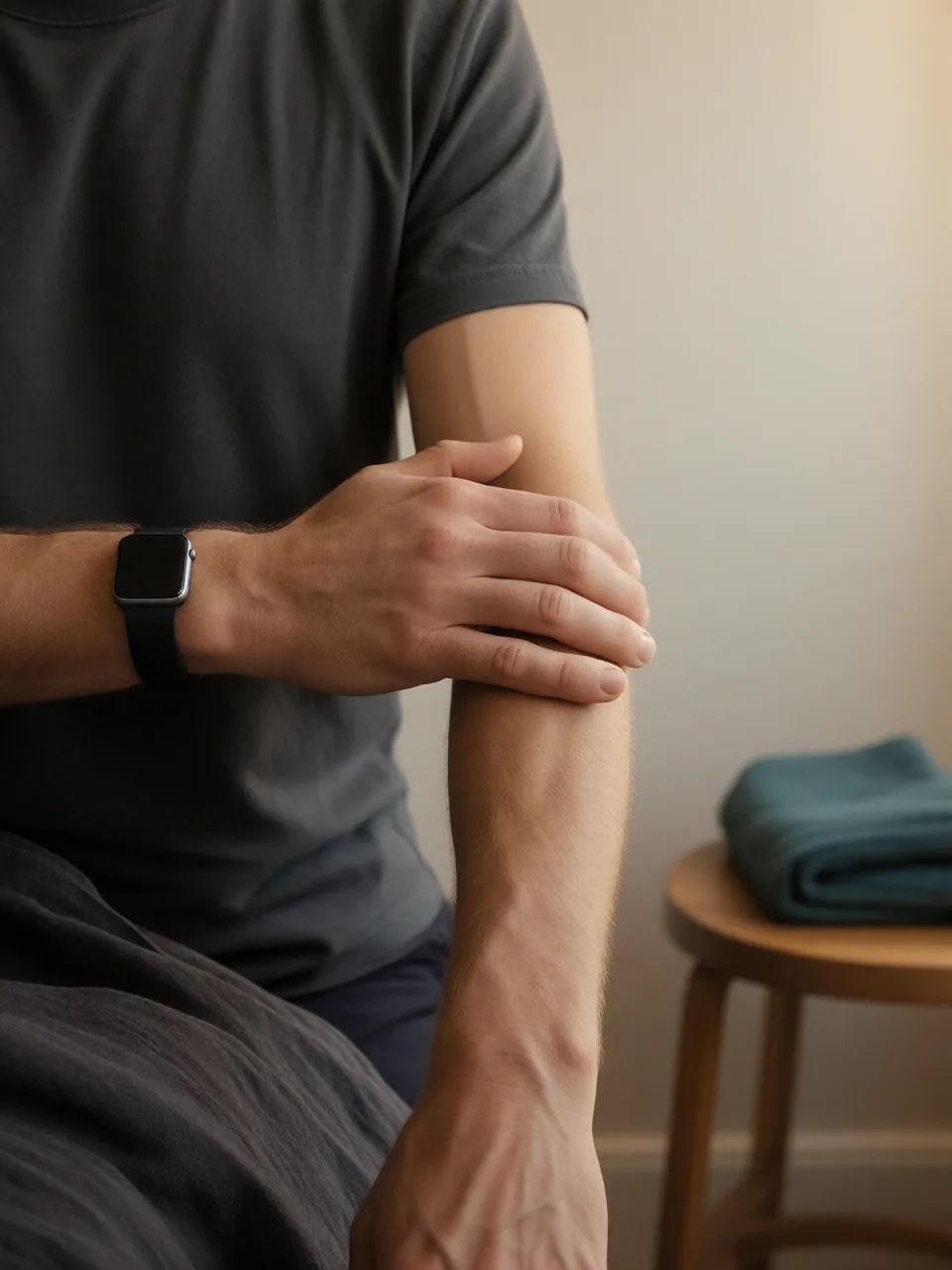
Gate control says the spinal cord is not a passive cable. It is a checkpoint that decides which signals get through to the brain, and it can be talked out of forwarding pain.
The mechanism turns on speed. Signals about pressure, movement, vibration, warmth, and cold travel on thick, well-insulated nerve fibers. Pain signals mostly travel on thin, poorly insulated ones. Insulation lets a nerve impulse leap along in jumps rather than crawling the whole length, so the thick fibers are much faster. When both kinds fire at once, the fast touch signal reaches the checkpoint first and, in effect, closes the gate on the slow pain signal behind it.
This is the physiology of rubbing a shin after you bang it, of a parent's hand on a bumped head, and of a good deal of what a massage accomplishes. It is also the physiology behind the mildest use of electrical stimulation: a comfortable, tingling current that never reaches the level of a contraction rides the fast lanes into the spinal cord and quietly crowds out whatever slower traffic is trying to get through. The pads that make a muscle contract can, at lower intensity, simply keep a gate busy.4
Gate control has limits. It does not explain chronic pain, and it does not explain pain with no tissue behind it at all. For those you need the second idea.
The matrix: pain is a verdict, not a reading
The neuromatrix model says pain is an output. The brain runs a wide, distributed network that continuously takes in three kinds of information: sensation from the body (where, how strong, how long, burning or aching or tingling), emotion (how you feel about the sensation), and cognition (what you think it means, colored by memory, belief, culture, and expectation). From all of that, the network produces a verdict. Pain is one of its possible outputs. Not the only one, and not a direct readout of any single input.
Two features of this model matter enormously for anyone lying on a table.
First, the same pressure can produce different pain depending on what you believe about it. A firm squeeze you have decided is "tissue being damaged" and an identical squeeze you have decided is "a muscle being worked" go into the same network with different cognitive inputs and come out with different verdicts. This is not a trick of attitude. It is how the system is built, and it is why pain education by itself measurably reduces chronic pain and disability.5 It is also why a therapist who says "this might hurt" has already made it hurt more.
Second, pain is not the only output. The network also produces involuntary motor responses, reflexes and spontaneous vocalizations, and stress responses: a jump in adrenaline and cortisol, a rise in heart rate, a shift toward the body's emergency mode. These outputs are published at the same time as the pain verdict, sometimes before the person has consciously registered it, and they are visible from the outside.
That second point is the design brief for your masseuse. It cannot ask you how much something hurts every three seconds. It does not need to. It listens for the gasp, the groan, the held breath; it watches for the brace and the flinch in the skeleton it draws over your body; it tracks the heart rate that was steady a moment ago and has started to climb. Those are not proxies for pain. They are the neuromatrix publishing its verdict on the channels that do not wait for words, and when they appear together the intensity comes down before you have to say anything.
Threshold, tolerance, and the wrong thing to be proud of
Two words from pain research clear up a lot of confusion on massage tables.
Pain threshold is the lowest intensity that registers as painful. Pain tolerance is the highest intensity a person can stand before it becomes unbearable. They are different properties, and only one of them is worth trying to change.
Tolerance is a test of will. You can push it up in the moment by gritting your teeth, and people are proud of a high one. But nothing about the tissue improves because you endured more, and there are real costs: guarding, spasm, soreness, and a nervous system that has just been taught this activity is a threat.
Threshold is a property of the system, and it moves. It drops with fear, poor sleep, catastrophizing, inactivity, and above all with pain somewhere else in the body, which is the single strongest predictor of feeling pain in a new spot. It rises with safety, predictability, warmth, movement, and, in people with painful conditions, with massage; several studies show massage improving pressure pain threshold, meaning it takes more pressure to hurt afterward, not less.6
There is a name for a threshold that has dropped far and stayed there: sensitization. The nervous system turns up its own volume, receptive fields widen, and things that should not hurt, a seatbelt across the shoulder, a friendly clap on the back, begin to. This is the modern picture of chronic pain.7 Acute pain does a job: it is roughly proportional to an injury and it fades as the injury heals. Pain that is still there months after the tissue has finished healing has stopped reporting on the tissue at all. It is reporting on the nervous system, and that makes it a condition of its own rather than a symptom of something else. Roughly one adult in nine lives there.
The good news inside that picture is the same as the bad news. A system that learned to turn the volume up can learn to turn it down, and the input that teaches it is safe, predictable, non-threatening sensation. Repeated.
So the wrong thing to be proud of is tolerance. The right goal is a rising threshold, and you do not get there by pushing through.
The jump sign: the profession's own stop rule
Massage has an informal instrument for detecting a crossed threshold, and it is disarmingly simple. When a therapist presses a spot and the person grimaces, winces, or makes a sound out of proportion to the pressure, that is called a jump sign.8 It is treated as information about the tissue (it is one of the ways trigger points are located) and as an instruction to the therapist: lighten, slow, or stop. A therapist who presses harder into a jump sign is, in the profession's own terms, doing it wrong.
Your masseuse encodes the same rule. A vocalization, a whole-body brace, and a heart rate jump arriving together are a jump sign, and the response is the one a good therapist gives: ease off, let the tissue settle, and approach more gradually. Not because the software is timid, but because the physiology says pressing on past that point makes the next contraction harder, not easier.
Which sensations are which
For anyone new to electro-massage, a plain-language guide to what you should and should not feel.
Expected. A tingle or buzz on the skin at low intensity. A tug or a pull as the muscle begins to respond. A squeeze, sometimes a deep one, as the contraction builds, then release. A pleasant heaviness in the muscle afterward. These are the fast-lane sensations: pressure, vibration, movement.
Not expected. Sharp. Stinging. Burning. Pins-and-needles that persist between contractions. These are nociceptor sensations, and in this context they usually mean something mechanical: a pad that has partly lifted so current is crowding through a small area, skin that was not clean and dry, or a pad over a spot that should have been left alone. Every one of them is a reason to stop and fix the setup, not to tolerate it. "Good hurt" is a concept from deep-tissue hands. It has no place at all in stimulation through skin.
The body's two modes, and how you know which one you are in
Underneath all of this sits the autonomic nervous system, with its two divisions. One dominates under threat and effort: heart rate up, vessels tightened, blood diverted from skin and gut toward muscle, stress hormones released. The other dominates in safety: heart and breathing slow, digestion resumes, the body conserves and repairs. Pain pushes toward the first. Moderate-pressure massage, slow rhythm, and predictable input pull toward the second.
Heart rate is the most accessible readout of which mode you are in, which is why your masseuse takes a baseline before it does anything and watches the direction of travel throughout. A session that is working sends the number down or holds it steady. A session that has crossed into threat sends it up, and the software treats that as the whole point of having the number.
Try this
- Before a session, human or otherwise, notice what you are telling yourself the sensation means. "This is a squeeze" and "this is damaging me" are different inputs to the same network.
- Report sensation in words, not just numbers. "Dull and spreading" and "sharp and local" are different animals even at the same rating.
- Treat a wince as data. If you caught yourself doing it, the pressure crossed your threshold, and asking for less is the informed choice, not the weak one.
- If you are working with masseuse.ai: stay in the camera's view, do not mute yourself, and let the machine hear the sigh. It is listening for exactly that.
Where the current never goes
masseuse.ai works below the waist, on intact skin, through hydrogel pads. Four rules are absolute:
- Never place pads across the chest or upper back so that current could cross the heart.
- Never stimulate the throat or the carotid sinus at the side of the neck.
- Never place pads across the head or temples.
- Not for anyone with a pacemaker, an implantable cardioverter-defibrillator, or an active neurological implant, unless a physician is supervising.
Start from zero and ramp up. Stop at the first sharp, stinging, or burning sensation.
References
- Salvo SG. Massage Therapy: Principles and Practice. 7th ed. Elsevier; 2024. Chapters 14 (pain theories, threshold, tolerance, and sensitization) and 23 (receptors, conduction speed, and the autonomic divisions). Publisher
- Melzack R, Wall PD. Pain mechanisms: a new theory. Science. 1965;150(3699):971-979. doi:10.1126/science.150.3699.971 · PubMed
- Melzack R. Pain and the neuromatrix in the brain. J Dent Educ. 2001;65(12):1378-1382. PubMed
- Vance CG, Dailey DL, Rakel BA, Sluka KA. Using TENS for pain control: the state of the evidence. Pain Manag. 2014;4(3):197-209. doi:10.2217/pmt.14.13 · PubMed
- Louw A, Diener I, Butler DS, Puentedura EJ. The effect of neuroscience education on pain, disability, anxiety, and stress in chronic musculoskeletal pain. Arch Phys Med Rehabil. 2011;92(12):2041-2056. doi:10.1016/j.apmr.2011.07.198 · PubMed
- Moraska AF, Schmiege SJ, Mann JD, Butryn N, Krutsch JP. Responsiveness of myofascial trigger points to single and multiple trigger point release massages: a randomized, placebo controlled trial. Am J Phys Med Rehabil. 2017;96(9):639-645. doi:10.1097/PHM.0000000000000728 · PubMed
- Woolf CJ. Central sensitization: implications for the diagnosis and treatment of pain. Pain. 2011;152(3 Suppl):S2-S15. doi:10.1016/j.pain.2010.09.030 · PubMed
- Simons DG, Travell JG, Simons LS. Myofascial Pain and Dysfunction: The Trigger Point Manual. Vol 1: Upper Half of Body. 2nd ed. Williams & Wilkins; 1999. WorldCat
masseuse.ai writes about wellness, not medicine. Nothing here diagnoses or treats a condition. If you have a health concern, talk to a clinician who can examine you.