Massage Therapy, Reconsidered · Part 8
The Plumb Line in Your Pocket: Posture, Kinesiology, and What a Camera Should and Should Not Tell You
Therapists have judged posture with a weighted string for a century, and the profession is honest about how unreliable that snapshot is. A phone camera that watches continuously can do better, if it compares you to yourself rather than to a chart.
By masseuse.aiUpdated 9 mins read
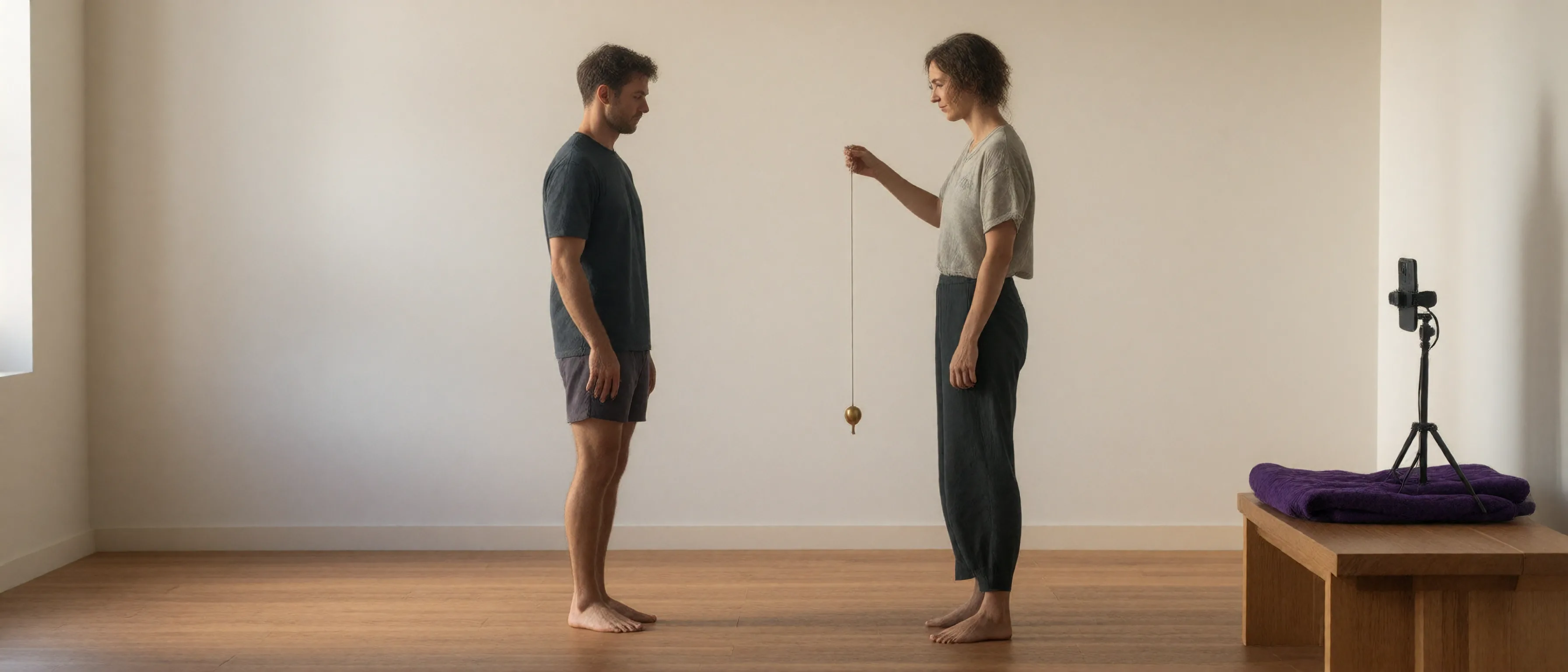
The oldest instrument in a massage clinic is a piece of string with a weight on the end. Hung from the ceiling beside a standing client, a plumb line shows the line of gravity, the vertical along which the body's weight falls toward its base. Everything a therapist wants to know about posture starts as a comparison to that line: what sits on it, what sits off it, and whether left matches right.
masseuse.ai draws a plumb line too, in software, and a couple of dozen landmarks along with it, from the same phone camera that watches for a clench. That makes this the right place to explain what the profession actually does with posture, how much it trusts the result, and what a camera that never blinks should do differently.
A shared language for where things are
Anatomy needs a compass, so anatomists agreed on a reference pose long ago: a person standing upright, looking ahead, arms hanging with the palms turned to the front, feet roughly a hip-width apart. Every "left," "above," and "toward the midline" in a medical text assumes that pose. From there, three imaginary planes slice the body. One divides left from right; forward and backward movements, like bending to touch your toes, happen in it. One divides front from back; side-to-side movements happen in it. One divides top from bottom; twisting happens in it.1
That is nearly all the vocabulary you need. A hip tilting forward is a front-back event. One shoulder higher than the other is a side-to-side event. A torso rotating on the hips is a twist. When a therapist says your pelvis is "anteriorly tilted," they mean it has rotated forward in the first plane, the top of the bowl dipping toward your toes.
What a therapist looks for
A formal postural assessment is a relaxed, barefoot, standing snapshot from three sides.
From the front, the plumb line should split the nose, the breastbone, the navel, and the pubic bone, and should fall midway between the knees and midway between the ankles. Left and right should match: shoulder tips level, hip crests level, kneecaps level, fingertips reaching the same point on each thigh. The gap between each arm and the body should be similar. Knees should point forward, neither collapsing inward (knock-kneed) nor bowing outward (bowlegged).
From the back, the line runs down the skull, the spine, and the crease of the buttocks to a point between the heels. The spine should be straight rather than curving sideways; the shoulder blades should sit at equal distance from it.
From the side, the line should pass through the ear canal, the tip of the shoulder, the hip joint, just in front of the knee, and just in front of the ankle bone. Off-line, a therapist notes a head carried forward of the shoulders, shoulders rolled forward, an upper back rounded beyond its normal curve (twenty to forty degrees is normal; beyond forty-five is called hyperkyphosis), a lower back arched beyond its normal curve (hyperlordosis, which travels with a forward-tilted pelvis), and collapsed arches, which undermine the whole base of support.1
Then comes gait: the person walks, and the therapist watches the cycle from one heel strike to the next, roughly sixty percent of it spent with the foot on the ground and forty percent with it swinging. A limp adopted to spare a painful side is the most common thing they see.
How much the profession trusts this
Here is the part that should make you trust the profession more, not less. Massage education teaches the whole procedure above and then, in the same breath, teaches students not to believe it too much. The objections are well known and well founded. A standing assessment captures one instant of a body that is never still. Reliability studies are unflattering: ask several trained examiners to mark the same landmark on the same person and they will disagree, and the disagreement grows on larger bodies.2,3 Posture is bent by mood, by fatigue, by illness, by how accurately a person's nervous system senses where their limbs are, and by plain habit. And so the ethical instruction that goes with the chart is blunt: a deviation from the diagram is something to ask about, not a verdict to deliver, and if it looks like it matters, it belongs with the client's physician.
That is a discipline being honest about its instrument. The plumb line is a good way to notice asymmetry and a poor way to judge a person. Posture is less a shape you have than a thing you are continuously doing, and a photograph of a verb is not very informative.
Kinesiology: why the shape looks the way it does
Kinesiology is the study of movement, and its central idea is that no muscle acts alone. For any motion there is a prime mover doing the main work, synergists helping, antagonists on the opposite side lengthening to allow it, and fixators, muscles whose whole job is to hold something still so the movers have a stable platform. Fixators are the posture muscles. When you lift a leg, the muscles around your pelvis and spine that keep your torso from toppling are doing as much work as the hip flexor doing the lifting.
Two rules of thumb from kinesiology explain most of what a therapist sees at the pelvis. Muscles on the front of the trunk generally flex; muscles on the back generally extend. And a muscle that crosses two joints acts on both. The hip flexors run from the lower spine and pelvis to the thigh, so when they are chronically short they do not just pull the thigh up; they tug the pelvis forward and the lower back into a deeper arch. The glutes and abdominals, their antagonists, lengthen and go quiet. The lower back muscles work overtime as fixators. The resulting shape, a forward-tilted pelvis with a tight lower back and a soft front, is the single most common pattern in people who sit all day, and it was described decades ago by the Czech physician Vladimir Janda as a crossed pattern of tight and inhibited muscles.4
The exaggerated lower-back arch is a good example, because it is so often a solution rather than a fault. Put extra weight out in front of the spine, a pregnancy, a heavy midsection, and the body's center of gravity drifts forward; the lower back tightens to haul it back over the feet, and stays tight because the weight stays. Nobody decides to do this. The fixators decide for you.
From a snapshot to a movie
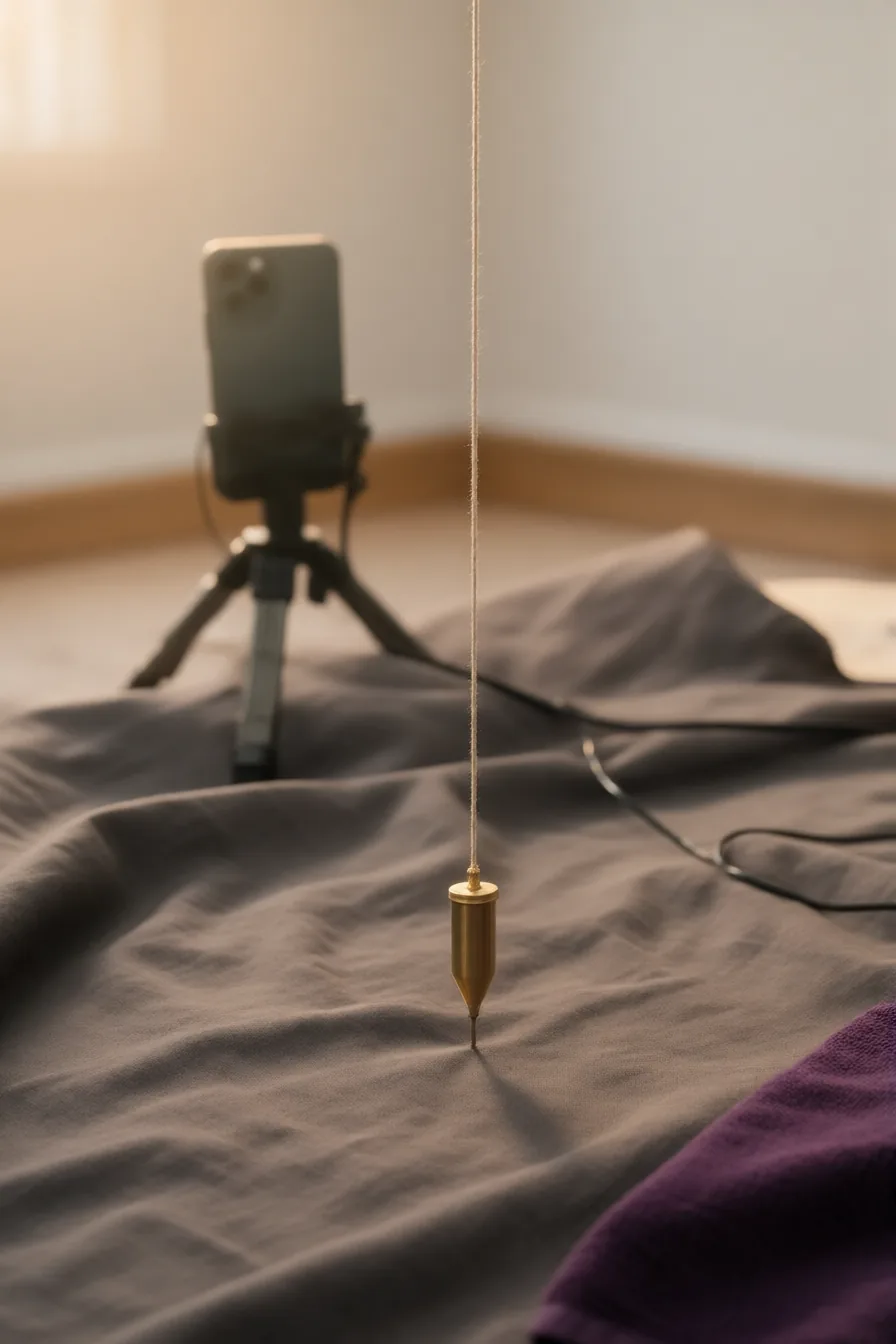
Now the camera. Your masseuse finds the same landmarks a therapist palpates: ears, shoulders, hips, knees, ankles, plus the wrists and a few points in between, and it tracks them continuously as you lie, sit, or move in front of the phone. That is not a better plumb line. It is a different kind of instrument, and the difference is what it should be used for.
It should compare you to yourself, not to a chart. The profession's own warning about the "standard" applies doubly to software, which can be very confident and very wrong. The valuable information is change: whether your hips settle more evenly this week than last, whether one side of the body braces earlier than the other, whether your lower back arches off the floor less as a session goes on. None of that requires an ideal to measure against. It requires a memory, and a camera that watches every session has one.
It should catch compensation in the act. The fixator story matters directly during electro-massage. When a contraction is stronger than your body finds comfortable, you do not usually say so; you compensate. The lower back lifts, a hip hikes, a shoulder braces against the floor, the knees drift. Those are fixators recruiting to stabilize against something the body has decided is a threat. A therapist would feel the client stiffen under their hands. Your masseuse sees the skeleton change shape and treats it the same way: intensity comes down, the rest phase gets longer. The same signal is read alongside the muscle clench itself, your breathing and vocal cues, and your heart rate, so no single channel has to carry the judgment alone.
It should check the setup, not just the person. Half of what a therapist does with body position is arranging it. For someone lying face up with a pronounced lower-back arch, that means a generous bolster under the knees so the pelvis can roll back and the arch can flatten; face down, a pillow under the belly does the same job. Before a session begins, your masseuse can see whether your hips are square, your knees supported, and your spine resting rather than held, and can tell you so before any current flows.
It should say less than it knows. A camera can measure the angle of your pelvis to a fraction of a degree. It should not announce a diagnosis on that basis, because the profession has established that landmarks are contested, that snapshots mislead, and that posture reflects mood as much as anatomy. A persistent asymmetry, a limp, pain that tracks with position: those are things to raise with a clinician who can examine you, and the honest role of the software is to notice them consistently enough that you cannot forget to.
What posture is for
The plumb line measures the line of gravity, and gravity is the one force every posture is negotiating with, all day, without a break. The posture muscles are the slow, tireless kind, and the cost of a poor negotiation is not a bad shape in a photograph. It is a set of fixators that never get to stand down: a lower back that tightens to hold up a forward-tilted pelvis, hip flexors that shorten to match, glutes and a pelvic floor that have stopped cycling because the arrangement above them never changes.
Which is why we care about posture at all. Not to correct it toward a chart, but because a body that lets go of its fixators during a session, that lies flatter, breathes lower, and stops bracing, is a body in which the muscles we are actually working can do the one thing we are asking of them: contract, and then fully release.
Try this
- A side-view photo, once a month, against a doorframe. Same spot, same clothes, relaxed, eyes forward. Compare it only to last month's. You are looking for change, not for a grade.
- The wall check. Stand with your heels, buttocks, shoulder blades, and head touching a wall. Slide a hand into the gap at your lower back. If your whole forearm fits, the pelvis is probably tilted forward, and the hip flexors and lower back are good places to spend some attention.
- The bolster trick. Lying on your back, put a thick cushion under your knees and notice how much of your lower back reaches the floor. That is what a pelvis at rest feels like. It is also the position your masseuse would like to see you in.
- Watch your own gait once. Have someone film you walking away and toward them. A stride that is even, with hips that stay level, is worth more than any static posture score.
Where the current never goes
masseuse.ai works below the waist, on intact skin, through hydrogel pads. Four rules are absolute:
- Never place pads across the chest or upper back so that current could cross the heart.
- Never stimulate the throat or the carotid sinus at the side of the neck.
- Never place pads across the head or temples.
- Not for anyone with a pacemaker, an implantable cardioverter-defibrillator, or an active neurological implant, unless a physician is supervising.
Start from zero and ramp up. Stop at the first sharp, stinging, or burning sensation.
References
- Salvo SG. Massage Therapy: Principles and Practice. 7th ed. Elsevier; 2024. Chapters 14 (postural and gait assessment and their limits), 18 (the body compass), 19 (spinal curves), and 21 (prime movers, synergists, fixators, and antagonists). Publisher
- Fedorak C, Ashworth N, Marshall J, Paull H. Reliability of the visual assessment of cervical and lumbar lordosis: how good are we?. Spine (Phila Pa 1976). 2003;28(16):1857-1859. doi:10.1097/01.BRS.0000083281.48923.BD · PubMed
- Seffinger MA, Najm WI, Mishra SI, et al. Reliability of spinal palpation for diagnosis of back and neck pain: a systematic review of the literature. Spine (Phila Pa 1976). 2004;29(19):E413-E425. doi:10.1097/01.brs.0000141178.98157.8e · PubMed
- Page P, Frank CC, Lardner R. Assessment and Treatment of Muscle Imbalance: The Janda Approach. Human Kinetics; 2010. WorldCat
masseuse.ai writes about wellness, not medicine. Nothing here diagnoses or treats a condition. If you have a health concern, talk to a clinician who can examine you.