Massage Therapy, Reconsidered · Part 7
Below the Waist: The Pelvic Floor, the Prostate's Neighborhood, and Why We Work From the Outside
A tour of the muscles that hold up the bladder, wrap the urethra, and sit under a gland most men never think about until it complains. What massage therapy teaches about this region, what it refuses to do, and where masseuse.ai fits.
By masseuse.aiUpdated 9 mins read
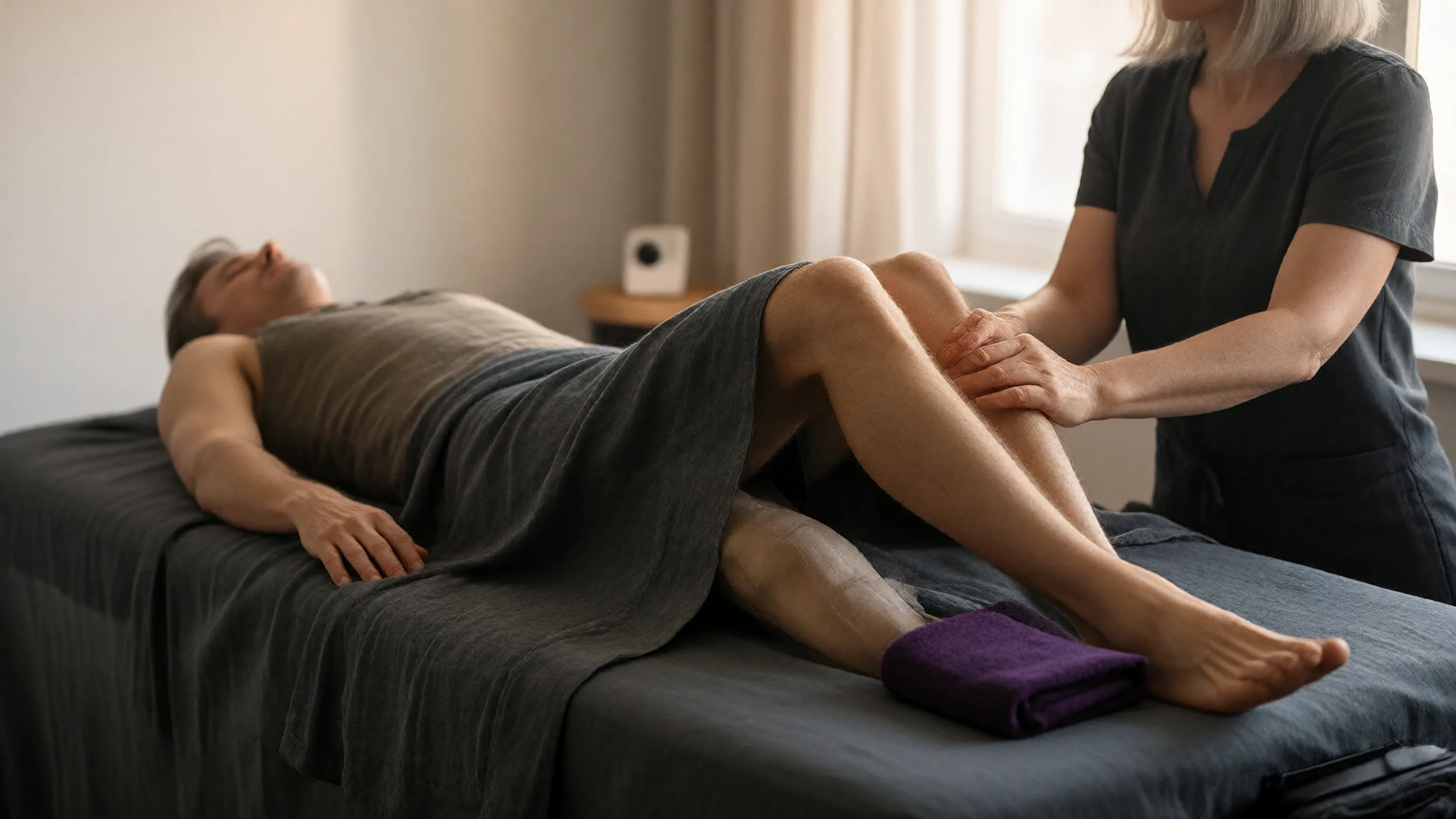
masseuse.ai describes what it does below the waist as training, and the word raises a fair question: what, exactly, is being trained?
Not the prostate. A gland does not have a workout. What can be trained is the muscular neighborhood the prostate lives in: the sling of muscle underneath it, the ring of muscle just below it, and the large hip muscles whose walls form the room. That neighborhood is where tension collects, where habits of holding are stored, and where the massage profession has a great deal to say, along with one firm boundary about where hands go. This post is a tour.
The floor of the room
Picture the pelvis as a bowl of bone. It has no bottom. What keeps the contents from falling through is a layered hammock of muscle slung from the pubic bone at the front to the tailbone at the back and out to the sitting bones on either side. That hammock is the pelvic floor.1
It does three jobs at once. It holds up the bladder, the bowel, and in men the prostate, against gravity and against every cough, laugh, and lift that spikes the pressure inside the abdomen. It closes and opens the passages that pass through it, on cue. And it is part of the machinery of sexual response: the rhythmic contractions of climax are produced by pelvic floor muscles around the root of the penis, firing on a reflex that lives in the spinal cord rather than the brain.
Because it is on duty all day, the pelvic floor is built largely from slow, fatigue-resistant fibers, the postural type described in an earlier post.2 That is a strength and a liability. A muscle designed to hold for hours is also a muscle that can forget it is allowed to stop.
The gland and the ring
The prostate is a small, doughnut-shaped gland that sits directly beneath the bladder and wraps around the urethra, the tube that carries urine (and semen) out of the body. It contributes an alkaline fluid to semen and, during ejaculation, helps close the path from the bladder so the two streams do not mix.1
Two rings of muscle control the outflow. The upper one, at the neck of the bladder, is smooth muscle and works without your say-so. The lower one, just below the prostate in men, is skeletal muscle and answers to voluntary command. This lower ring is what you tighten to stop a stream midway, and it is part of the pelvic floor. So the prostate is sandwiched: bladder above, voluntary sphincter below, hammock underneath, and the whole arrangement threaded by the same tube.
That geometry is why this region is so sensitive to muscle tension. A pelvic floor that has settled into low-grade, constant contraction changes the pressures around the urethra, the resting state of the sphincter, and the sensations that get reported upward. Holding and letting go are a partnership between the bladder's own wiring and the skeletal muscle of the floor, and the partnership only works if both halves show up. When the "release" half is weak, holding is all that is left.
When holding goes wrong in both directions
Bladder control problems are usually described as a weakness story, and often they are. The most common form of leakage happens when a pressure spike from a cough or a jump overwhelms a pelvic floor that cannot clamp hard enough. Roughly twenty-five million people in the United States live with some degree of bladder leakage, and while women account for most cases, men are far from exempt, particularly after prostate procedures.1,3
But there is a second story, less told, in which the floor is not weak but stuck. A pelvic floor that never fully relaxes cannot generate a strong contraction either, because a muscle that is already partly shortened has less range left to work with. It also cannot get out of the way when it is supposed to. The result can be a frustrating mix: urgency, incomplete emptying, and a floor that fails the strength test not because the fibers are weak but because they are tired and tight.4
This is the case for training the release as deliberately as the squeeze, and it is where massage thinking becomes useful. A therapist facing a chronically tight muscle anywhere else in the body does not prescribe more strengthening. They work on getting it to let go, and then rebuild strength on top of a muscle that has its full range back.
The walls of the room
The pelvic floor does not live alone. Its neighbors shape it.
Lining the inside of the pelvic bowl on each side is a broad muscle, the obturator internus, whose sheet of connective tissue is where part of the pelvic floor takes its anchor.5 Behind it, the piriformis runs from the sacrum out to the top of the thigh bone. Above and behind everything are the gluteal muscles, the largest in the body, and along the inner thigh run the adductors, which attach right at the pubic bone where the floor begins.
Every one of these muscles is a hip muscle, which is to say a movement muscle, and every one of them is a known collector of tension in people who sit for a living. A tight piriformis or a clenched pair of glutes changes the shape and tone of the floor slung beneath them. Massage therapists work these muscles constantly, from the outside, through the skin of the buttock and thigh, and clients frequently report that the sense of relief extends inward, to a place the hands never went.
So there are two ways to help the neighborhood. Relax the walls, which is classic hip work. And teach the floor to cycle, which is contract-and-release training. Your masseuse is built to do both.
Where hands do not go
Here the profession is unambiguous, and it matters that we are too. Licensed massage therapy does not include the genitals or the anus. A therapist who works the hips, glutes, inner thighs, and lower abdomen is working the prostate's neighborhood exactly as far as the profession permits, and no farther. Internal examination of the prostate is a medical act performed by clinicians. Whatever the phrase "prostate massage" conjures, it is not something a massage therapist does, and it is not something masseuse.ai does either.
Everything in our approach happens on the outside. Hydrogel pads go on intact skin over the large muscles of the hips and upper thighs, never on mucous membranes, never on broken skin, never anywhere the safety rules exclude. The camera watches the same surface a therapist would see. The stimulation makes the underlying muscles contract and release. The pelvic floor is reached the way a therapist reaches it: through its neighbors and through its own reflexive participation in what the hips are doing.
What masseuse.ai is actually doing down there
Put the pieces together and a session looks like this.
It reads the clench. From the skeleton the camera draws over your hips and legs, and from the surface of the glutes, it can see when the region tightens and when it lets go. It counts clenches, notices their rhythm, and, most usefully, notices when a clench that should have ended has not. For a muscle group most people cannot feel with any precision, an outside observer that can is a genuine advantage.
It relaxes the walls. Stimulation patterns over the glutes and upper thighs run the contract-rest cycles described in the rest-beat post: a moderate contraction that ramps in, a rest phase at least as long that ramps out, repeated in threes. This is the electrical version of the rhythmic compression a therapist would apply with a forearm to the same muscles, and it engages the same muscle pump that moves blood out of the pelvis and back toward the heart.
It trains the floor to cycle. When the hip muscles contract, the pelvic floor participates reflexively, and when they release, so does it. Each cycle is a rehearsal of the full range: engage, and then completely let go. The camera confirms the letting-go happened before the next contraction is allowed to start. If it did not, the rest gets longer and the intensity comes down. The release is the lesson; the contraction is just how the lesson begins.
It keeps you in the calm branch. The autonomic nervous system's rest-and-restore division emerges from two places: the brainstem and the sacrum, at the base of the spine, which is why the pelvic organs are so responsive to it. Arousal, digestion, and elimination are all rest-mode events; the body does them poorly while braced. Slow rhythm, predictable cycles, and a heart rate trending downward are how your masseuse keeps the session on the correct side of that line, and the heart rate reading is how it knows.
Two housekeeping notes from the clinic
Two pieces of housekeeping follow from all this, and they matter more at home than they would on a therapist's table. Use the bathroom before you start; anything that presses on or contracts the region is more comfortable that way. And do not treat a pause in the middle as a failure. Nobody relaxes a pelvic floor while trying not to need the bathroom.
Before you start: cautions specific to this region
- Fever or infection. A urinary tract infection with fever is an absolute stop, as it would be for any massage. Wait until a full day has passed without fever and without fever-reducing medication.
- Recent pelvic surgery, biopsy, or procedure. The area is off limits until your clinician says the tissue has healed. Scars need two months or more before any local work.
- Implanted devices. Some people have small implanted stimulators near the sacrum for bladder control. Those are active neurological implants, and rule four applies without exception: not without a physician supervising.
- Pain, blood, or a change you have not had checked. Muscle tension is common; it is also not the only thing that causes symptoms in this region. A wellness routine is not a substitute for a urologist, and it should not delay one.
- Anything sharp, stinging, or burning during a session. Stop, check the pads, check the skin.
Try this
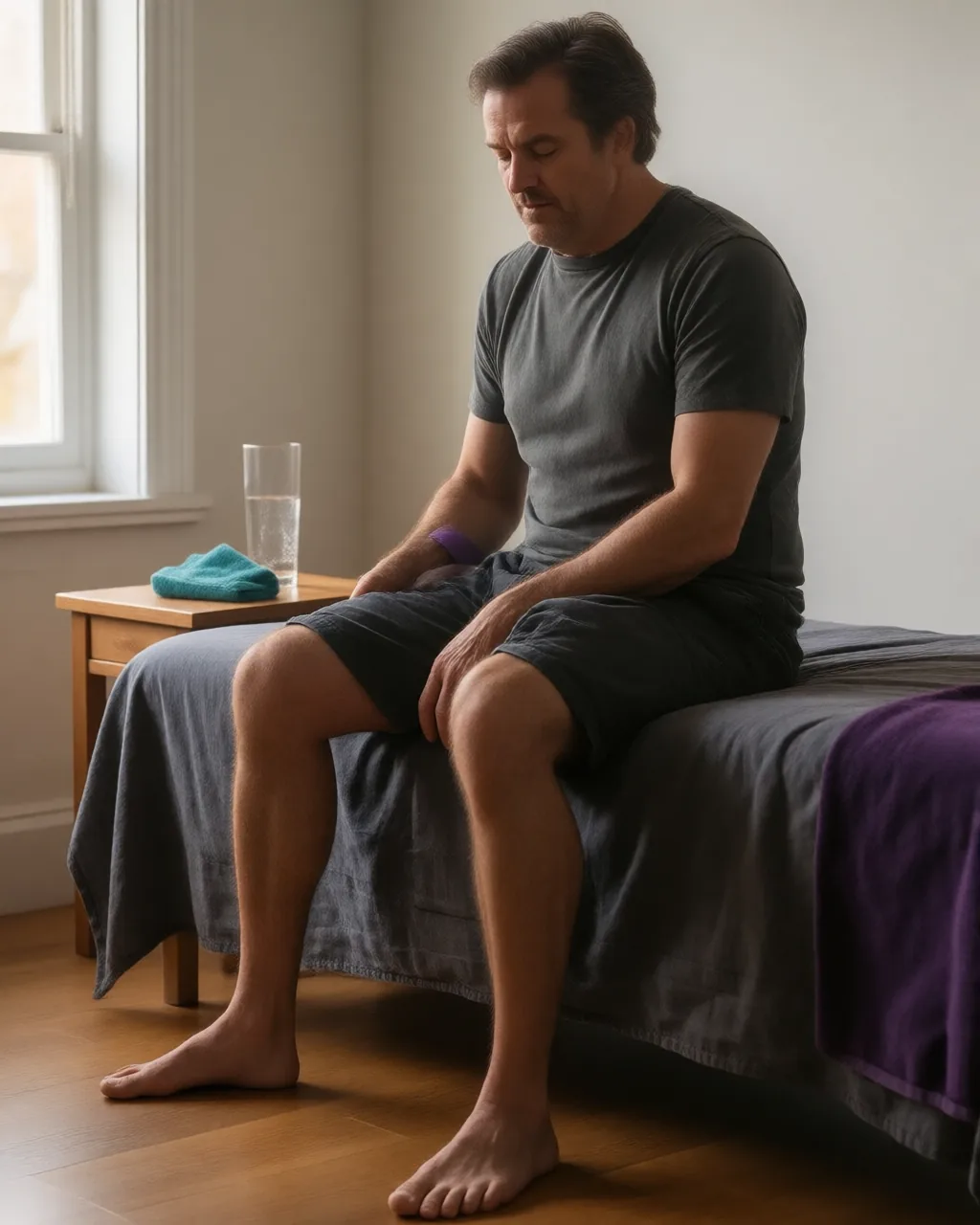
- Find the release, not the squeeze. Sit comfortably. Contract the pelvic floor gently, as if stopping a stream, for two seconds. Then spend six seconds letting go, and keep going past the point where you think you are done. Most people discover a second layer of release under the first.
- Relax the walls first. Before any floor work, a few minutes on a foam roller or a firm ball under each buttock, slowly, at a pressure you would call a six out of ten, changes what the floor beneath can do.
- Exhale to release. The floor descends on the out-breath. Time your letting-go to it.
- With masseuse.ai: empty your bladder, prop the phone so it can see your hips and knees, and let the session run its cycles. Your job is to not help. The machine can see whether you are helping.
Where the current never goes
masseuse.ai works below the waist, on intact skin, through hydrogel pads. Four rules are absolute:
- Never place pads across the chest or upper back so that current could cross the heart.
- Never stimulate the throat or the carotid sinus at the side of the neck.
- Never place pads across the head or temples.
- Not for anyone with a pacemaker, an implantable cardioverter-defibrillator, or an active neurological implant, unless a physician is supervising.
Start from zero and ramp up. Stop at the first sharp, stinging, or burning sensation.
References
- Salvo SG. Massage Therapy: Principles and Practice. 7th ed. Elsevier; 2024. Chapters 25 (the prostate and male accessory glands), 30 (the urethral sphincters and urinary incontinence), and 21 (the deep hip muscles). Publisher
- Gosling JA, Dixon JS, Critchley HO, Thompson SA. A comparative study of the human external sphincter and periurethral levator ani muscles. Br J Urol. 1981;53(1):35-41. doi:10.1111/j.1464-410x.1981.tb03125.x · PubMed
- Anderson CA, Omar MI, Campbell SE, Hunter KF, Cody JD, Glazener CM. Conservative management for postprostatectomy urinary incontinence. Cochrane Database Syst Rev. 2015;(1):CD001843. doi:10.1002/14651858.CD001843.pub5 · PubMed
- Faubion SS, Shuster LT, Bharucha AE. Recognition and management of nonrelaxing pelvic floor dysfunction. Mayo Clin Proc. 2012;87(2):187-193. doi:10.1016/j.mayocp.2011.09.004 · PubMed
- Raizada V, Mittal RK. Pelvic floor anatomy and applied physiology. Gastroenterol Clin North Am. 2008;37(3):493-509. doi:10.1016/j.gtc.2008.06.003 · PubMed
masseuse.ai writes about wellness, not medicine. Nothing here diagnoses or treats a condition. If you have a health concern, talk to a clinician who can examine you.