Massage Therapy, Reconsidered · Part 9
East Meets Electrode: What Shiatsu, Thai Massage, and Ayurveda Knew About Stillness, Rhythm, and the Wind Below the Navel
Three Asian bodywork traditions arrived at the same practical wisdom by different roads: hold still, use weight not effort, let the tissue set the timing, keep one hand listening. We borrow the practice, not the metaphysics, and say which is which.
By masseuse.aiUpdated 10 mins read
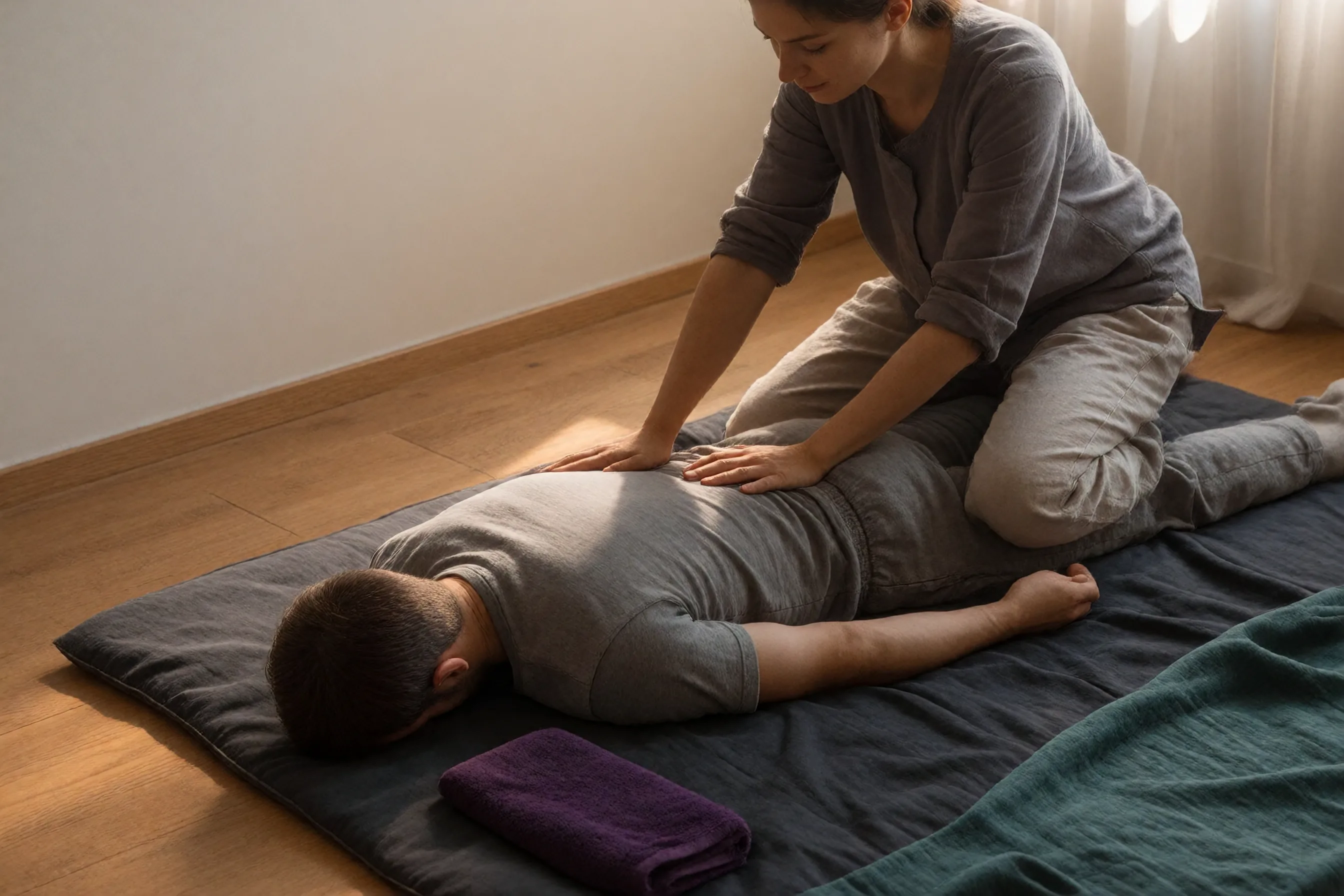
Western massage describes what it does in the language of tissue: fascia, fibers, fluid, nerve. The bodywork traditions of Japan, Thailand, and India describe what they do in the language of energy: ki, wind, the three doshas. It is tempting to treat the second vocabulary as either mystical truth or quaint error. Neither is useful. A better question is what practitioners in these traditions actually do with their hands and their attention, because they have been refining that for a very long time, and the practical answers hold up regardless of how you explain them.
This post is about those practical answers. We will be clear about which parts we borrow (the practice) and which we do not claim (the metaphysics), and we will land, as always, on what it means for a machine that works through hydrogel pads below the waist.
Shiatsu: weight, stillness, and the listening hand
Shiatsu is Japanese finger pressure, though in practice palms, elbows, knees, and feet do much of the work. It is done on a floor mat, fully clothed, with no oil, and it is built on a handful of principles that read, a century on, like a design document for careful touch.1
Use body weight, not force. The founders noticed something every therapist learns the hard way: muscular effort cannot be sustained. A practitioner who presses with contracted arms tires within the hour and works worse as they tire. One who leans, letting gravity do the pressing, can work all day. The principle is ergonomic, but it produces a particular quality of pressure, steady and unhurried, that clients feel as calm rather than as being worked on.
Stationary, perpendicular pressure. Shiatsu does not rub. The practitioner finds the angle straight into the body at that point, leans in, holds, and releases before moving on. Rubbing or circling is discouraged on the grounds that it keeps the effect shallow, a matter of skin and muscle rather than of the whole person. Whatever one makes of the explanation, the instruction is precise: arrive straight, hold still, leave cleanly.
Two hands, one listening. The Zen shiatsu lineage names them. The "mother hand" rests in one place, still and receptive, feeling how the body reacts. The "child hand" moves and works. Both stay on the same line of the body, and at least one hand never leaves the client.2 The mother hand is the tradition's answer to a question we asked in the first post of this series: how do you know what the body thinks of what you are doing? You keep one instrument dedicated entirely to finding out.
Let the point set the duration. Shiatsu sorts the places it presses into two kinds. One feels empty, soft, cool, unresponsive; the practitioner holds there longer, patiently, until something stirs, and then moves on. The other feels full, hard, tender, reactive; the pressure is brief, just enough to disperse, and then off. Translate out of the energetic vocabulary and you have an adaptive rule: dwell where the tissue is slow to respond, and do not linger where it is already fired up. When you feel a change, that is the signal to leave.
One channel at a time. Work the whole line before moving to the next, in a consistent, fluid order, rather than jumping around the body. Sequence is part of the treatment.
And one instruction about humility that every shiatsu curriculum drills: a finding on the channel named for the heart is not a finding about the heart. Practitioners are taught never to translate a channel reading into a statement about the organ that shares its name, because it frightens people and because it is a diagnosis they are neither trained nor licensed to make. Any system that reads the body, with thumbs or with cameras, should carry the same rule.
Thai massage: compression under a stretch, slowly
Thai massage is sometimes called partner yoga, and the description is exact. The client lies clothed on a mat and is moved, slowly, through a series of assisted postures, while the practitioner applies compression with palms, thumbs, elbows, knees, and feet along lines the tradition calls sen. The northern style, which most Western schools teach, is deliberately slow, and the tradition gives two reasons that both matter to us.1
Slowness keeps both people in a meditative, attentive state. And slowness is a safety mechanism: because every movement unfolds gradually, every movement can be stopped or adjusted before it goes too far. Speed is where injuries live.
The signature Thai move pairs compression with stretch. The practitioner's body weight pins one region of the client still while another region is lengthened. Readers of the reflex post will recognize this immediately: pressure into a muscle while its length is being taken to a barrier, which is also the shape of the contract-and-stretch techniques that Western clinical massage arrived at from the physiology side. Two traditions, one movement.
Thai theory organizes the body around three interacting essences: the physical body, energy, and citta, the whole non-physical person of thought, emotion, will, and aspiration. Ask a Thai practitioner what they are actually doing and the answer, in the tradition's vocabulary, is working on wind: the element responsible for everything that moves, which they aim to get moving again wherever it has stalled. The tool for this is rhythmic compression: press, release, press, release, at a steady cadence. The parallel to rhythmic compression in Western technique, and to a stimulation pattern's contract-rest cycle, is not a stretch.
The tradition also states its values plainly. Practitioners are asked to work from the four brahmaviharas of Buddhist teaching, often translated as the divine abodes: goodwill toward the person on the mat, compassion for what hurts them, gladness at what goes well for them, and a steadiness of mind that does not wobble when the work gets hard. That is not an unusual thing for a healing tradition to ask of its practitioners. It is an unusual thing to ask of software, and we think it should be asked anyway. More on that below.
Ayurveda: three temperaments and the wind below the navel
Ayurveda is the traditional medical system of India, several thousand years old, and Thai medicine grew from it. Like a lot of ancient medicine it starts from a short list of elements and builds up: earth, water, fire, air, and space pair off into three temperaments, the doshas, and every body runs on a blend of all three with one usually in charge.
Vata is the airy one, and the one that matters most for this series. It is the dosha of motion and of the nerves, and the tradition characterizes it with a string of adjectives you could apply to a nervous person: cold, dry, light, quick, erratic. Out of balance, it produces restlessness, anxiety, and pain. And its territory, according to the classical texts, is the lower body: hips, pelvis, thighs, legs, bladder, and bowel, with the colon as its seat.1
Pitta is the fiery one: digestion, metabolism, heat, and intensity, with a territory in the middle of the body. Out of balance it runs hot, toward inflammation and irritability.
Kapha is the earthy one: structure, lubrication, stability, and patience, with a territory in the chest and head. Out of balance it runs heavy, toward congestion and slowness.
We are not going to tell you which dosha you are. What we find striking is the map. A tradition working entirely from observation placed restlessness, nervous energy, and pain in the pelvis and legs, and prescribed for it the opposite of its qualities: warmth, regularity, steadiness, slowness, oil, routine. That is a remarkably good description of what a tight, overactive pelvic floor needs, and of what a well-designed session provides. Ayurveda also locates the first of its energy centers at the base of the spine, and its marma points, pressed by hand to move the body's winds, lie along channels that begin deep in the pelvis. Whatever the model, the traditions keep pointing at the same neighborhood.
One caution from Ayurvedic practice that carries over directly: the traditional oils, and essential oils generally, have been linked to contact dermatitis in a meaningful number of cases.3 If you use them, patch-test, and never under or near an adhesive pad. Oil and hydrogel are not friends.
What we borrow, and what we do not
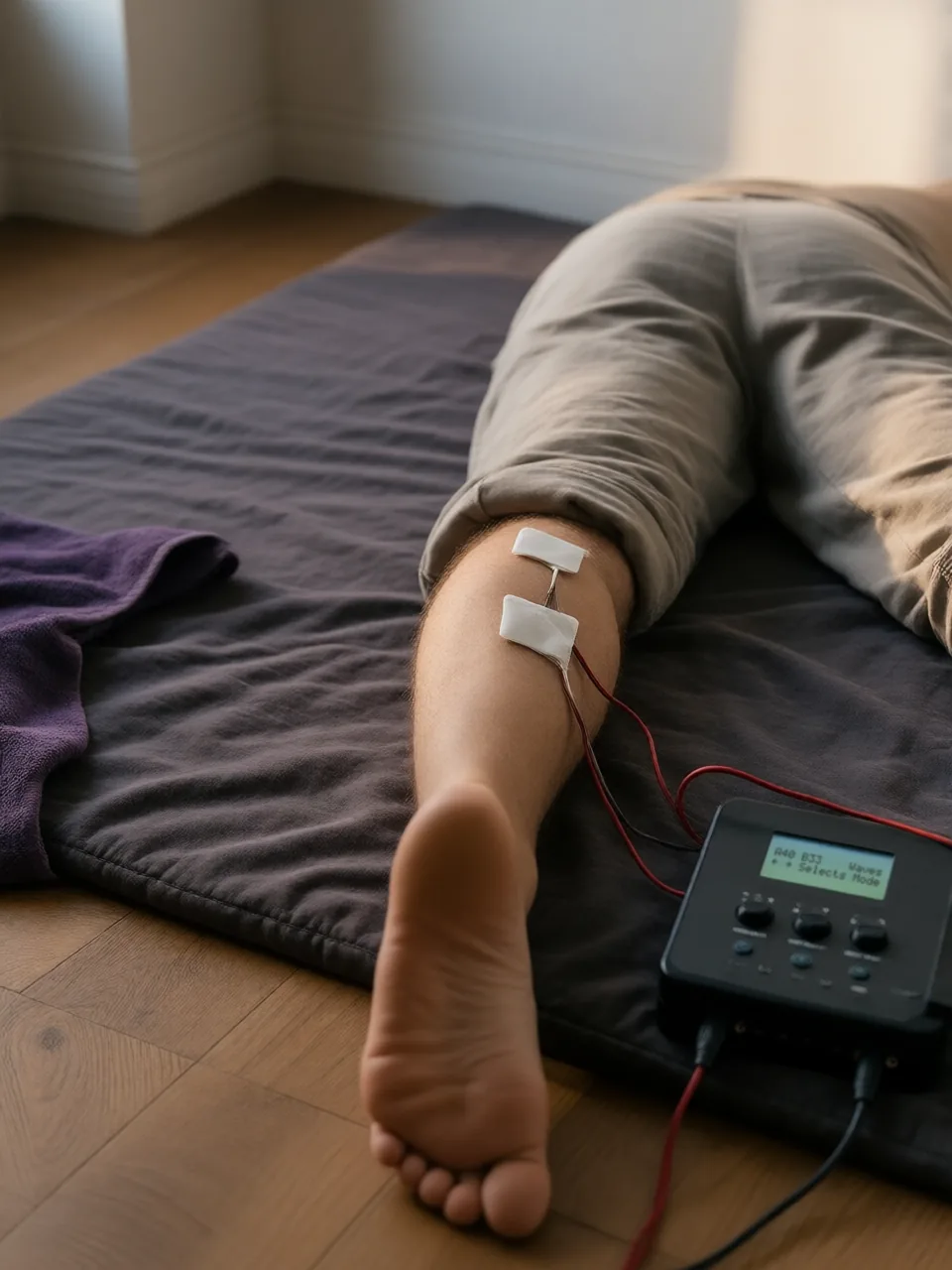
We do not claim that current moves ki, frees wind, or balances a dosha. We do not have a way to measure those things, and the traditions themselves are careful about over-reading their findings. What we claim is narrower and, we think, more durable: that three lineages of skilled practitioners, working over centuries with nothing but hands and attention, converged on a set of practices that hold up under any explanation, and that a machine doing bodywork should inherit them.
Hold still; do not rub. A stimulation pattern is stationary by nature. The pads do not slide. Each contraction arrives straight into the muscle, holds, and leaves cleanly. Shiatsu would approve of the form even if it had no opinion about the mechanism.
Weight, not effort. The shiatsu insight about practitioner fatigue has a mirror image in electro-massage: the machine never tires, but the muscle does. The duty cycle, work followed by generous rest, is our version of leaning rather than pushing. It keeps the working tissue in the range where it can keep responding for the whole session.
Let the tissue set the duration. The empty-point, full-point rule becomes concrete when a camera is watching the muscle. A region that is slow to respond gets a longer, gentler dwell. A region that is already braced, reactive, clenched before the contraction even arrives, gets less, not more, and gets it briefly. When the camera sees the change it was waiting for, a clench that finally dissolves in the rest phase, that is the signal to move on, exactly as a shiatsu practitioner moves on when something stirs under the thumb.
A mother hand that never lifts. The camera, the microphone, and the heart rate reading are the still, receptive hand. They do not work; they listen, continuously, for how the body is reacting to the hand that does. Your masseuse never has only one hand on you.
Slow enough to stop. Every ramp, up or down, is the Thai principle in electrical form: nothing changes faster than it can be halted. A session that ramps over seconds can always be caught before it goes too far.
One channel at a time. Sessions follow a sequence, walls of the room before the floor, larger muscles before smaller, rather than jumping between regions. Predictability is part of the treatment, in Tokyo and in your living room.
Equanimity in the software. Here is the one we take most seriously. A practitioner in the Thai tradition is asked to remain even-minded under stress, kind, and glad for the client's wellbeing. For a machine, the equivalent is simple to state and demanding to build: it never escalates in response to a body that is resisting. A gasp, a brace, a rising heart rate are not obstacles to push through. They are the client speaking, and the only acceptable response is to back off, wait, and try again more gently. masseuse.ai is built so that the intensity can only go one direction when the body objects: down.
The clock
One last borrowed idea. Traditional Chinese medicine, which shiatsu inherits, describes a daily cycle in which each organ system has its hour, the so-called noon-to-midnight law. Modern physiology calls the same phenomenon circadian rhythm and finds it everywhere: hormone levels, body temperature, muscle performance, and the balance between the body's alert and restful modes all follow a daily curve. The practical advice is old and unglamorous. Do restful things at restful times. A session in the evening, in a warm room, at a steady rhythm, is working with the clock. The same session squeezed between two meetings is working against it, and the heart rate reading will say so.
Try this
- Borrow the mother hand. Next time you self-massage anywhere, keep one hand still on the body while the other works. Notice how much more you feel.
- Arrive straight, hold, leave. On a tight spot in the glute or thigh, press straight in with a thumb or a ball, hold without moving for a slow breath or two, and lift cleanly. Compare it to rubbing. Most people find the stillness goes deeper.
- Make it a routine. Ayurveda's answer to a restless lower body is regularity. Same time, same warm room, same sequence, most days. The nervous system learns from repetition, not from intensity.
- With masseuse.ai: evenings, warm, unhurried, phone propped where it can see you, and let the machine keep its listening hand on you while you do nothing at all.
Where the current never goes
masseuse.ai works below the waist, on intact skin, through hydrogel pads. Four rules are absolute:
- Never place pads across the chest or upper back so that current could cross the heart.
- Never stimulate the throat or the carotid sinus at the side of the neck.
- Never place pads across the head or temples.
- Not for anyone with a pacemaker, an implantable cardioverter-defibrillator, or an active neurological implant, unless a physician is supervising.
Start from zero and ramp up. Stop at the first sharp, stinging, or burning sensation.
References
- Salvo SG. Massage Therapy: Principles and Practice. 7th ed. Elsevier; 2024. Chapter 16 (Asian bodywork therapy: the Zen shiatsu principles, northern-style Thai massage, and the doshas). Publisher
- Masunaga S, Ohashi W. Zen Shiatsu: How to Harmonize Yin and Yang for Better Health. Japan Publications; 1977. WorldCat
- de Groot AC, Schmidt E. Essential oils, part IV: contact allergy. Dermatitis. 2016;27(4):170-175. doi:10.1097/DER.0000000000000197 · PubMed
masseuse.ai writes about wellness, not medicine. Nothing here diagnoses or treats a condition. If you have a health concern, talk to a clinician who can examine you.