Massage Therapy, Reconsidered · Part 6
The Body's Own Wiring: Three Reflexes That Turn a Contraction Into a Release
Therapists have used contract-then-relax tricks since the 1940s. They work because of three circuits in the spinal cord. Here is how those circuits behave, how hands exploit them, and what happens when the contraction arrives by wire.
By masseuse.aiUpdated 10 mins read
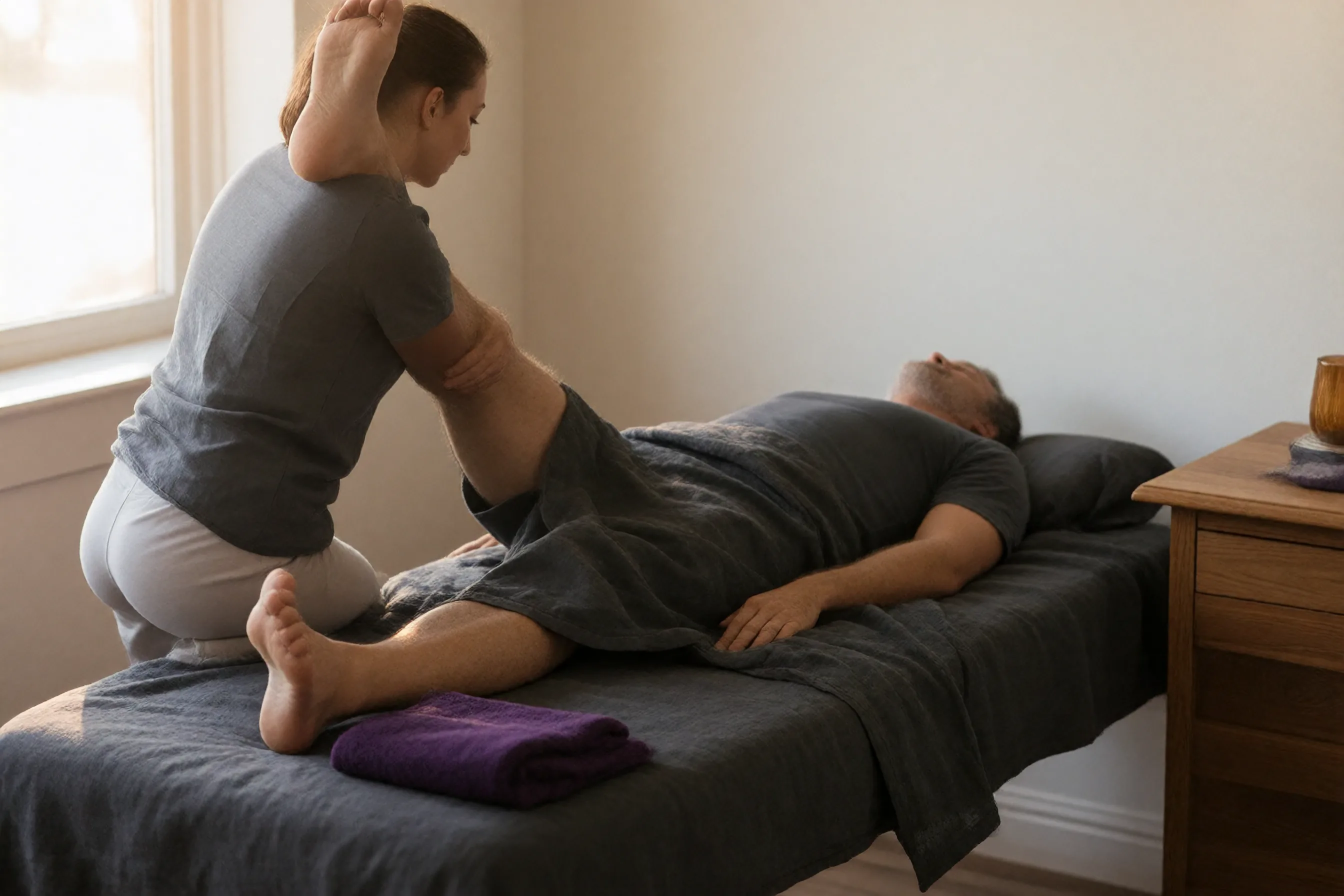
There is a moment in a clinical massage that looks like a magic trick. The therapist lifts your leg until the hamstring goes taut, then asks you to push gently down against their shoulder. Five seconds. You relax, they lift again, and the leg goes noticeably farther than it did before. No pounding, no pain, no "breathing into it." Just a small contraction followed by a bigger release.
The trick is not in the therapist's hands. It is in your spinal cord, which contains a handful of circuits that automatically convert certain kinds of contraction into relaxation. Therapists have exploited these circuits since the 1940s. They are the reason a tight muscle can be talked out of its tightness rather than forced. And they do not much care where the contraction came from, which is the part that matters to us.
Three circuits
A reflex is the simplest thing a nervous system does: a sensor, a nerve to the spinal cord, a nerve back out, and a response, all without the brain having to weigh in. The brain can turn a reflex up or down, but it cannot switch it off. Three reflexes shape every stretch you will ever do.
The stretch reflex, and the sensor that runs it. Woven through every muscle are small sensory fibers called muscle spindles, lying parallel to the working fibers and reporting two things: the muscle's current length and the speed at which that length is changing.1,2 If a stretch comes on suddenly, the spindle fires and the muscle contracts to protect itself from tearing. The knee-jerk test is this reflex: the tap stretches the thigh muscle for an instant, and the leg kicks. So is the jolt in your arm when a grocery bag turns out to be heavier than it looked.
Spindles are also why bouncing into a stretch is self-defeating. Every bounce is a sudden lengthening, every sudden lengthening triggers a protective contraction, and you end up fighting the muscle you meant to loosen. Slow stretching sneaks under the spindle's speed threshold. This is also the sensor that sets muscle tone: even at rest, spindles keep a low hum of contraction going so you do not collapse.
The tendon reflex, and the governor. Where muscle meets tendon sit sensors of a different kind, Golgi tendon organs, that respond not to length but to tension. When tension climbs high, from a hard contraction or a long stretch, they signal the spinal cord to inhibit the muscle: motor output drops, the muscle lets go, and the tendon is spared.2 Think of the governor on an engine, throttling output before it climbs past what the machinery can survive. A muscle can generate more force than its own tendon and bony attachment can safely take, and this reflex is a large part of why that force is so rarely used.
Spindles respond to stretch; tendon organs respond to tension. The distinction is easy to blur and worth keeping sharp, because the second reflex is the one therapists actually harness. Generate tension on purpose, and the body's own governor kicks in, and for a short window the muscle is more willing to lengthen than it was a moment ago.
Reciprocal inhibition. Muscles work in opposing pairs. When the nervous system tells one to contract, it simultaneously tells its opposite to stand down, so the two do not fight. The English physiologist Charles Sherrington formalized this over a century ago: contraction of one muscle is accompanied by inhibition of its antagonist.3,4 Flex your elbow hard and the muscle on the back of your arm is being actively quieted, not just stretched.
Add a fourth principle that is less a reflex than a habit of the whole system: pathways that fire together get easier to fire. Sherrington's contemporaries called it the law of facilitation, and the modern version is the neuroscientist's slogan that neurons that fire together wire together. Every trip a signal makes along a route makes the next trip cheaper. This is how skills form. It is also how guarding forms: a muscle that has clenched in response to stress a thousand times has worn a groove, and the groove is why "just relax" does nothing. Grooves are overwritten by repetition in the other direction, not by instruction.
How hands use the circuits
Two professions built technique families on these reflexes within a decade or so of each other, for different reasons. In osteopathy, Fred Mitchell Sr. and his son were after a gentler way to shift joints back into alignment; the result was the muscle energy techniques.5 In physical therapy, Herman Kabat and Margaret Knott were trying to coax strength out of muscles weakened by polio; the result was proprioceptive neuromuscular facilitation.6 Different problems, same reflexes, and in the end nearly the same sequence of moves. Head-to-head research finds them about equally effective for pain, range of motion, and function.7,8,9
The sequence:
- Stretch the target muscle to its barrier, meaning the point where resistance is first felt or where it begins to hurt, whichever comes first.
- Have the person contract against the therapist's resistance without moving. Muscle energy techniques ask for about a quarter of full effort held three to ten seconds; the physical therapy version asks for about half effort held ten to thirty.
- Relax completely.
- Stretch again. The barrier has moved. Repeat two to four times.
Step two is doing two things. The tension trips the tendon organs, which inhibit the muscle. The effort also tires the muscle slightly, so for a few moments it is less able to put up a fight. Step four exploits that short window before it closes, taking the muscle to a new resting length while the spindles are reset.
There are two flavors. You can contract the tight muscle itself, then stretch it (called post-isometric relaxation, or contract-relax). Or you can contract its opposite, so reciprocal inhibition quiets the tight one for you, then stretch (called reciprocal inhibition, or antagonist-contract). Both are effective; the second is useful when contracting the tight muscle itself would hurt.
Around all of this sit the plain rules of stretching that every massage student learns.1 A touch of traction on the joint before the movement starts. Begin as the person exhales. Stop at the first hint of tension in the target, not at the point of strain. Hold ten to thirty seconds. Repeat three times. Never push past the point where the bones themselves stop the motion. Creaks and pops along the way are usually nitrogen bubbles in the joint fluid and are normal.
When the contraction arrives by wire
Now the question we have been building toward. Electrical stimulation through hydrogel pads produces a contraction. The tendon organs measuring tension at the far end of the muscle have no way to know whether the command came from your brain or from a pad. Tension is tension. The governor answers either way.
That opens a version of contract-relax that asks nothing of you.
- Position. You take the target muscle to its barrier, a comfortable stretch, with your masseuse confirming from the skeleton it draws over you that your hips, knees, and feet are where they should be for that stretch and that you are not compensating by twisting elsewhere.
- Contract. The stimulation ramps up to a moderate level, roughly the effort of the quarter-strength contraction a therapist would ask for, and holds for several seconds. You do nothing. Your only job is not to fight it.
- Release. The current ramps down. Here the camera earns its place: it watches the muscle under the pads dissolve from clenched to slack, and that is the cue to ease deeper into the stretch, because the window the reflexes have opened is short. A stopwatch would guess at the moment. The camera sees it.
- Repeat, in threes. Each cycle takes the barrier a little farther. Each cycle wears the groove a little deeper in the direction you want: contract, and then genuinely let go.
For the muscles of the pelvic floor, which are hard to isolate voluntarily and even harder to stretch with a strap, this is the version of contract-relax that is actually available to most people. The stimulation supplies the squeeze; the rest beat that follows is the practice of releasing; and the pattern repeats often enough to start overwriting the habit of holding on. The letting-go is the exercise. The contraction is just how you get there.
The muscle pump
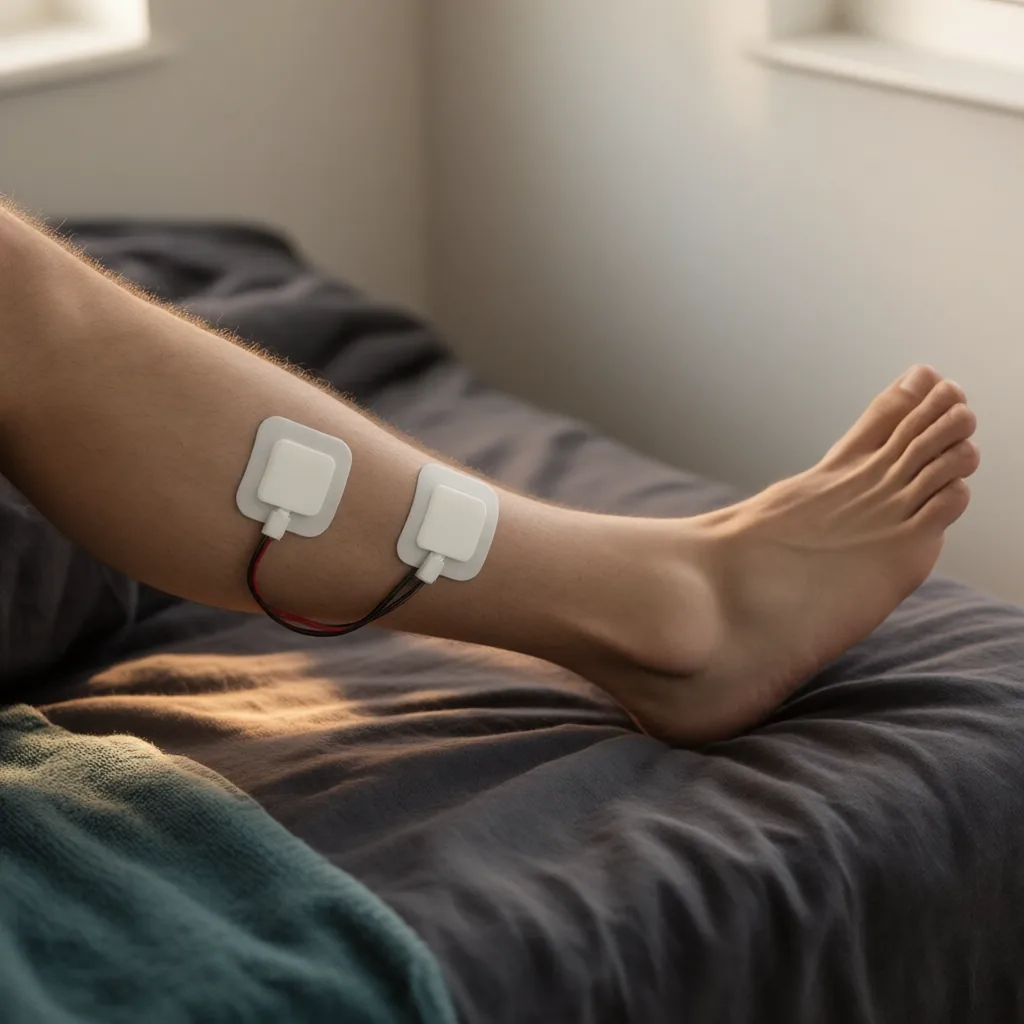
There is a second, quieter reason contract-relax cycles feel good in the legs and hips, and it has nothing to do with reflexes.
Veins have no pump of their own. Blood returns to the heart from the legs against gravity, helped by one-way valves and by two borrowed engines: the pressure changes of breathing, and the squeeze-and-release of the skeletal muscles around the veins. Every time a calf or thigh muscle contracts it compresses the veins running through it and pushes blood upward past the next valve; every time it relaxes, the veins refill from below. Physiology calls this the skeletal muscle pump, and it is the reason your legs feel heavy after a long flight and better after a walk.10
A stimulation cycle in the thighs and glutes runs this pump for you. Contraction: squeeze the veins. Rest: refill. Contraction: squeeze. It is the same mechanism a therapist engages with rhythmic compression from the outside, with one difference: the muscle is doing it from the inside, which is how the pump was designed to be driven. Elevating the legs slightly during a session adds gravity to the effort.
One firm caveat, repeated from the safety post because it matters most here. A pump is exactly the wrong thing to run in a leg that might contain a clot. Swelling, heat, redness, or tenderness in one leg and not the other, especially after immobility or surgery, means no stimulation and no massage there until someone has examined it.
A closing thought on grooves
The law of facilitation is not often quoted to clients, and it should be. It says the nervous system is a record of what it has done most. If it has mostly clenched, clenching is easy and release is effortful. Three contract-relax cycles once will not change that. Three cycles, several times a week, with the release always given more time than the squeeze, will. The circuits are already in you. Repetition is what teaches them which way to fire.
Try this
- A self-applied hamstring release. Lie on your back with a strap around one foot. Raise the leg to the first sense of tension. Exhale, then press the foot gently into the strap at about a quarter of your strength for five seconds. Let go completely. Raise the leg to the new barrier. Three rounds.
- The exhale rule. Whatever you are stretching, begin the movement as you breathe out. The spindles are calmer on the exhale.
- Release longer than you squeeze. For any contract-relax, on the pelvic floor or anywhere else, spend at least twice as long letting go as you spent contracting. If you cannot feel the release, you are done for today; more squeezing will not help.
- With masseuse.ai: get into the stretch first, then start the session, and treat the ramp-down of each contraction as the moment to sink deeper. Stay in frame so the camera can see the release and time the cue.
Where the current never goes
masseuse.ai works below the waist, on intact skin, through hydrogel pads. Four rules are absolute:
- Never place pads across the chest or upper back so that current could cross the heart.
- Never stimulate the throat or the carotid sinus at the side of the neck.
- Never place pads across the head or temples.
- Not for anyone with a pacemaker, an implantable cardioverter-defibrillator, or an active neurological implant, unless a physician is supervising.
Start from zero and ramp up. Stop at the first sharp, stinging, or burning sensation.
References
- Salvo SG. Massage Therapy: Principles and Practice. 7th ed. Elsevier; 2024. Chapters 23 (reflex arcs, spindles, tendon organs, and Sherrington's laws), 14 (muscle energy techniques and PNF), 8 (stretching principles), and 26 (venous return and the skeletal muscle pump). Publisher
- Proske U, Gandevia SC. The proprioceptive senses: their roles in signaling body shape, body position and movement, and muscle force. Physiol Rev. 2012;92(4):1651-1697. doi:10.1152/physrev.00048.2011 · PubMed
- Sherrington CS. Decerebrate rigidity, and reflex coordination of movements. J Physiol. 1898;22(4):319-332. doi:10.1113/jphysiol.1898.sp000697 · PubMed
- Sherrington CS. The Integrative Action of the Nervous System. Yale University Press; 1906. Internet Archive
- Chaitow L. Muscle Energy Techniques. 4th ed. Churchill Livingstone; 2013. WorldCat
- Adler SS, Beckers D, Buck M. PNF in Practice: An Illustrated Guide. 4th ed. Springer; 2014. doi:10.1007/978-3-642-34988-1
- Hosseini SM, Rezaei H, Razmjoo S. Comparative effects of static stretching, PNF, MET, Graston, and foam rolling on hamstring flexibility in adolescent soccer players: a randomized controlled trial. BMC Sports Sci Med Rehabil. 2026;18(1):158. doi:10.1186/s13102-026-01566-3 · PubMed
- Thomas E, Cavallaro AR, Mani D, Bianco A, Palma A. The efficacy of muscle energy techniques in symptomatic and asymptomatic subjects: a systematic review. Chiropr Man Therap. 2019;27:35. doi:10.1186/s12998-019-0258-7 · PubMed
- Hindle KB, Whitcomb TJ, Briggs WO, Hong J. Proprioceptive neuromuscular facilitation (PNF): its mechanisms and effects on range of motion and muscular function. J Hum Kinet. 2012;31:105-113. doi:10.2478/v10078-012-0011-y · PubMed
- Rowland TW. The circulatory response to exercise: role of the peripheral pump. Int J Sports Med. 2001;22(8):558-565. doi:10.1055/s-2001-18526 · PubMed
masseuse.ai writes about wellness, not medicine. Nothing here diagnoses or treats a condition. If you have a health concern, talk to a clinician who can examine you.