Massage Therapy, Reconsidered · Part 10
Relax on Purpose: What Five Body Systems Do When a Session Is Working
Relaxation is not a mood. It is heart, breath, glands, lymph, and gut switching modes together, and every one of them leaves a trace you can see. A closing tour of the whole-body session, and a checklist for knowing it worked.
By masseuse.aiUpdated 12 mins read
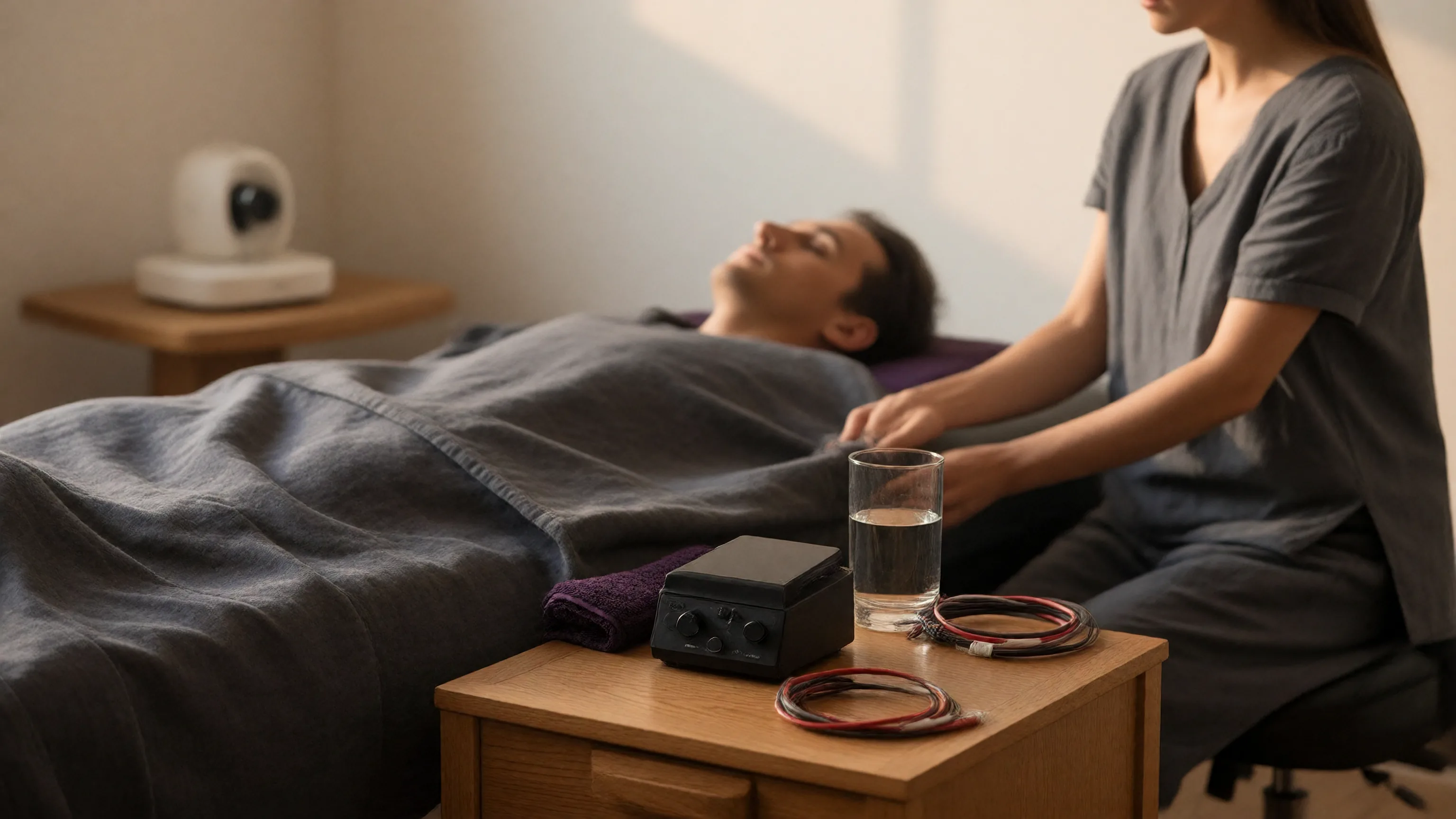
"Just relax" is the least useful instruction in bodywork, because relaxation is not something a person does. It is something several body systems do together, on their own schedule, when they collectively decide the environment is safe. The good news is that every one of those systems leaves a trace on the surface. Heart, breath, glands, lymph, and gut all change gear together, and if you know what to look for, you can watch the shift happen in real time.
This is the closing post of the series, and it is a tour of that shift: what each system does when a session is working, what it does when a session is not, and how the whole thing assembles into a session you can run at home. At the end there is a checklist, because relaxation, done on purpose, is a skill, and skills need feedback.
The switch
Underneath everything is a two-position switch in the autonomic nervous system. One position is for effort and threat: heart rate up, vessels tightened, blood diverted from skin and gut toward muscle, stress hormones released. The other is for safety: heart and breathing slow, digestion resumes, blood returns to the periphery, the body repairs and conserves. The two divisions run to most of the same organs and pull in opposite directions, so the body is always somewhere on a continuum between them.
The hormonal arm of the stress position runs from the hypothalamus to the pituitary to the adrenal glands, which sit on top of the kidneys and release cortisol from their outer layer and adrenaline from their core.1 Cortisol is not a villain; it has a daily rhythm and does essential work. The problem is a system that cannot get out of the stress position, so cortisol stays high when it should have dropped and the body never gets its repair window.
The clearest evidence that massage moves the switch comes from studies of moderate-pressure work: heart rate falls, and activity in the vagus nerve, the main cable of the safety division, rises.2,3 Cortisol falls in some studies, though a 2011 meta-analysis found that effect small.4,5 There is also a rise in oxytocin, a hormone made in the hypothalamus that is best known for its role in childbirth and nursing and increasingly studied for its part in trust, attachment, and bonding.6 Whether a machine can produce the oxytocin effect is an open question; the research is on human touch, and we will not pretend otherwise. What a machine can do is measure the switch, and the first place to measure it is the heart.
The heart
A normal resting heart rate for an adult sits between sixty and one hundred beats a minute, and lower at rest generally implies a fitter heart.1 A single number, though, tells you less than its direction. A heart rate that drifts downward over a session is a body sliding toward the safety position; one that climbs is a body that has decided something is a threat, whether or not the person would put it that way.
There is a more subtle readout than the rate itself. Heart rate variability, the small variations in timing from one beat to the next, is controlled by the same two divisions of the autonomic system, and high variability is a sign of a system that moves easily between effort and recovery: it can rise to a challenge and settle again afterward without getting stuck in either mode. Low variability means it is stuck, usually in the stress position, and it has been linked to cardiovascular disease and to poor recovery.7 A relaxed nervous system is not a slow one. It is a flexible one.
masseuse.ai takes a baseline heart rate before anything begins and watches the slope from there. A session that is working sends the number down or holds it steady; a session that has crossed into threat sends it up, and the intensity follows it down. The heart is the tiebreaker when the other signals disagree.
The breath
Breathing is the only part of the autonomic system you can grab with both hands. Everything else, heart rate, gut motility, hormone release, has to be coaxed. Breath can simply be done differently, and when it is, the rest of the system tends to follow.
The mechanics matter for understanding why. On the inhale, the diaphragm, a broad dome of muscle under the lungs, contracts and drops, the ribcage lifts, and the belly rises to make room. On a quiet exhale, nothing contracts at all: the diaphragm relaxes, the lungs and ribs recoil elastically, and air leaves on its own. Exhalation, at rest, is a passive event. It is the body's built-in demonstration of letting go, twelve to twenty times a minute.
Emotion rewrites the breath before we notice it has changed. Some states flatten it and slow it down; others quicken it; a startle can stop it outright for a beat or two. Massage therapists are taught to watch the breath as a tracking cue for exactly this reason: face-down, it shows in the rise and fall of the lower back; face-up, in the belly. A breath that goes shallow or stops is a body that has stopped consenting.
Slow, deep breathing is also a lever in its own right; the standard texts credit it with tipping the autonomic system toward its rest position, and it is the one intervention in this post that costs nothing and needs no equipment.1,8 Lengthening the exhale in particular leans on the body's own passive phase. And breathing is a pump: the pressure changes in the chest and abdomen on each cycle help draw blood and lymph up out of the legs and pelvis toward the heart. From the camera's point of view, the belly is the most honest thing in the frame.
The lymph
The lymphatic system is the body's drainage and defense network: a one-way set of vessels that collects the fluid leaking out of capillaries into the tissues, filters it through bean-shaped nodes clustered in the neck, armpits, and groin, and returns it to the bloodstream near the collarbones. Unlike blood, lymph has no heart. It moves slowly and irregularly, and it depends on borrowed engines: skeletal muscles squeezing and releasing the vessels that run through them, the pressure swings of breathing, small contractions in the vessel walls themselves, one-way valves, and pressure from outside, which is where massage comes in.
Two practical consequences. First, the lymph-moving work of massage is light, around a three on the ten-point pressure scale, because the vessels are shallow and collapse under heavy pressure; deep work does not help lymph, it stops it.1 Second, a swollen node is what therapists call a local contraindication: the session can go on, but that spot is left alone. Nodes enlarge when they are fighting something, and the right response is to keep hands and pads away and, if they stay enlarged, ask a clinician.
The engine that does most of the daily lymph work is the same one that carries blood back up from the legs to the heart: muscles contracting and relaxing. A walk drains the legs. So does a sequence of contract-rest cycles through the thighs and glutes, which is why people often describe legs as feeling lighter after a session, and why a body that has been still for hours, on a flight or at a desk, is the body that benefits most. The usual caveat stands: never in a leg that might contain a clot.
The gut
Digestion is the safety division's signature activity. Its nickname, rest-and-digest, is not a metaphor: the wave-like muscular contractions that move food along the tract are initiated by the parasympathetic system and suppressed by the stress system, because a body preparing to run has no interest in lunch. If your stomach knots before a difficult conversation and unknots afterward, you have felt the switch from the inside.
The pelvic floor is part of this system too. Elimination requires the floor to release on cue, and a floor that has learned to hold cannot. It is one more reason a session aimed at the pelvis is really a session aimed at the switch.
Massage has a small, concrete offering here. Abdominal massage has a respectable evidence base for constipation,9,10 and the principle behind every version of it is the same: lie back with the knees supported so the belly goes soft, and stroke gently in the direction the colon actually runs, which from your own point of view is a clockwise circle, up the right side, across, and down the left. Slow, moderate, comfortable, and it stops at any pain, because the abdomen is an area of caution. It works as well as it does partly because it is a signal to the switch: this body is lying down, unhurried, and being tended. Digest.
The glands, and the clock
The endocrine system ties the rest together through timing. Cortisol peaks in the morning and falls through the day. Melatonin, from a small gland deep in the brain, rises in the evening and prepares the body for sleep. The safety division of the nervous system has an easier time taking over when these curves are on its side, which is the physiological version of the advice in the previous post: do restful things at restful times. A session in the evening, in a warm room, with the lights down, is not just pleasant. It is working with the hormones instead of against them.
Putting the session together
Everything in this series converges on a session that has a shape, and the shape is the same whether the therapist has hands or pads.
Set the room. Warm, since cold tightens everything and shunts blood inward. Quiet. Evening if you can. Empty your bladder. Lie on your back with a thick cushion under your knees so the lower back settles toward the floor and the belly softens. Prop the phone where the camera can see you from head to feet. Clean, dry, lotion-free skin under the pads, pressed down firmly.
Take the baseline. Your masseuse reads your resting heart rate and watches your breath for a minute before anything happens. This is what everything afterward is compared against.
Begin slowly. The first minutes are the electrical version of long, light gliding strokes: low intensity, slow rolling patterns, the body being introduced to the sensation and the nervous system deciding it is not a threat. Nothing about this phase is filler. It is where consent is established.
Work the walls, then the floor. The middle of the session runs the contract-rest cycles described in the rest-beat post, on the large hip and thigh muscles first, then with the pelvic floor participating. Contractions ramp in and out. Rest phases are at least as long as work phases, longer early on. The camera confirms that each rest actually produced a release before the next contraction begins; if the muscle stays visibly tight into the rest window, the rest lengthens and the intensity drops. Breath, voice, posture, and heart rate all vote continuously, and any one of them can lower the intensity. None of them can raise it.
Use the release. If you are pairing the session with a stretch, the moment each contraction ramps down is the moment to sink deeper. The reflexes have opened a short window; the camera cues it.
End slowly. The last minutes taper the way a massage tapers, back to low, slow, rolling sensation and then to nothing. Massage never closes with percussion; a session never closes with a contraction. The body should be given time to notice that it is done.
Get up carefully. Lying still for half an hour relaxes the muscle tone in the walls of your veins, and standing up quickly afterward can produce a moment of dizziness as blood pools in the legs. Roll to your side, sit for a minute, then stand. Drink some water. Expect, about one time in ten, a little heaviness in the muscles the next day, gone within a day or two.11 Anything sharper or longer is a reason to pause and reassess.
The checklist: how you know it worked
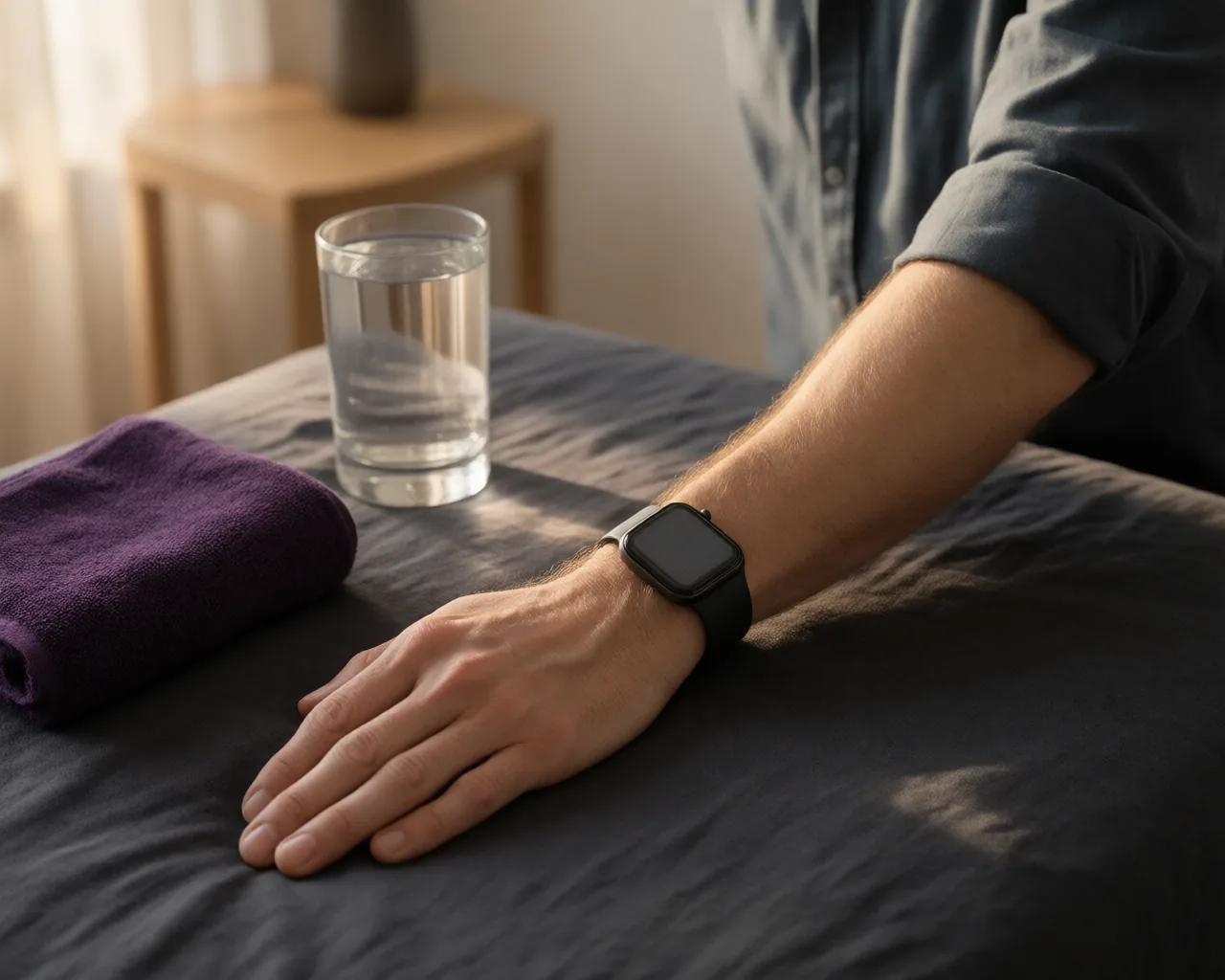
Relaxation is a measurable event. Here is what it looks like from the outside, which is what your masseuse is watching for and what you can watch for yourself.
- Breath low and slow. The belly rises more than the chest, and the exhale is longer than the inhale, without you managing it.
- Heart rate down or steady. Compared to the baseline at the start, not to some ideal.
- Hands and feet open. Curled fingers and gripping toes are the earliest brace and the last to let go.
- Lower back on the floor. The gap under the spine closes as the hip flexors and back muscles stand down.
- Voice soft, or absent. A sigh is a good sign. A held breath or a sharp sound is the opposite.
- Clench dissolves completely in every rest phase. The muscle under the pads goes fully slack between contractions, not merely less tight.
- Warmth in the legs. Blood has returned to the periphery, which means the switch has moved.
If most of these are true by the middle of a session, the session is working. If they are not, the correct response is never more intensity. It is a longer rest, a slower ramp, a warmer room, or simply another day.
What the series was about
Ten posts, one argument. A great massage is an act of attention, and force is a distant second. Everything the tradition teaches, from tracking a client's breath to the six strokes to the rest between trigger point holds to the humility of a postural assessment to the listening hand of shiatsu, is a way of paying attention to a body and letting it set the terms. masseuse.ai was built to inherit that discipline: to watch, listen, and measure more channels than a human can, to act only within the four rules that never bend, and to treat every objection from the body as the most important information in the room.
The body already knows how to relax. It just needs to be convinced it is safe. That is the whole job, and it is worth doing on purpose.
Where the current never goes
masseuse.ai works below the waist, on intact skin, through hydrogel pads. Four rules are absolute:
- Never place pads across the chest or upper back so that current could cross the heart.
- Never stimulate the throat or the carotid sinus at the side of the neck.
- Never place pads across the head or temples.
- Not for anyone with a pacemaker, an implantable cardioverter-defibrillator, or an active neurological implant, unless a physician is supervising.
Start from zero and ramp up. Stop at the first sharp, stinging, or burning sensation.
References
- Salvo SG. Massage Therapy: Principles and Practice. 7th ed. Elsevier; 2024. Chapters 24 (the HPA axis and oxytocin), 26 (heart rate and heart rate variability), 27 (how lymph moves), 28 (the mechanics of breathing), and 29 (rest-and-digest and abdominal massage for constipation). Publisher
- Field T, Diego M, Hernandez-Reif M. Moderate pressure is essential for massage therapy effects. Int J Neurosci. 2010;120(5):381-385. doi:10.3109/00207450903579475 · PubMed
- Diego MA, Field T. Moderate pressure massage elicits a parasympathetic nervous system response. Int J Neurosci. 2009;119(5):630-638. doi:10.1080/00207450802329605 · PubMed
- Field T, Hernandez-Reif M, Diego M, Schanberg S, Kuhn C. Cortisol decreases and serotonin and dopamine increase following massage therapy. Int J Neurosci. 2005;115(10):1397-1413. doi:10.1080/00207450590956459 · PubMed
- Moyer CA, Seefeldt L, Mann ES, Jackley LM. Does massage therapy reduce cortisol? A comprehensive quantitative review. J Bodyw Mov Ther. 2011;15(1):3-14. doi:10.1016/j.jbmt.2010.06.001 · PubMed
- Morhenn V, Beavin LE, Zak PJ. Massage increases oxytocin and reduces adrenocorticotropin hormone in humans. Altern Ther Health Med. 2012;18(6):11-18. PubMed
- Shaffer F, Ginsberg JP. An overview of heart rate variability metrics and norms. Front Public Health. 2017;5:258. doi:10.3389/fpubh.2017.00258 · PubMed
- Zaccaro A, Piarulli A, Laurino M, et al. How breath-control can change your life: a systematic review on psycho-physiological correlates of slow breathing. Front Hum Neurosci. 2018;12:353. doi:10.3389/fnhum.2018.00353 · PubMed
- Lämås K, Lindholm L, Stenlund H, Engström B, Jacobsson C. Effects of abdominal massage in management of constipation: a randomized controlled trial. Int J Nurs Stud. 2009;46(6):759-767. doi:10.1016/j.ijnurstu.2009.01.007 · PubMed
- Sinclair M. The use of abdominal massage to treat chronic constipation. J Bodyw Mov Ther. 2011;15(4):436-445. doi:10.1016/j.jbmt.2010.07.007 · PubMed
- Cambron JA, Dexheimer J, Coe P, Swenson R. Side-effects of massage therapy: a cross-sectional study of 100 clients. J Altern Complement Med. 2007;13(8):793-796. doi:10.1089/acm.2006.6401 · PubMed
masseuse.ai writes about wellness, not medicine. Nothing here diagnoses or treats a condition. If you have a health concern, talk to a clinician who can examine you.